Consumption or demand certificate
Getting an energy performance certificate online: process, details and how to recognise reputable providers

Christoph Werker Energieberater & Geschäftsführer
As of:
You need an energy performance certificate, type “get one online” into the search box — and pause. Can a document be official if nobody sets foot in your house for it? This article is written for owners of a residential building who are facing exactly this question. The short answer: the law does not know the word “online” at all. It knows requirements for the person who signs and for the data used in the calculation.

The article answers six questions in this order: what happens on the online route technically and what legally, whether anyone looks at the building at all, which details you should have ready beforehand, how the order proceeds, how to recognise a disreputable provider — and in which cases the online route does not work.
What “getting it online” means legally
An energy performance certificate (Energieausweis) ordered online is not a document of its own. It carries the same mandatory details as any other, the same registration number and the same period of validity of ten years from issue.1 The governing law is the Building Modernisation Act (Gebäudemodernisierungsgesetz, GModG) — the name the Building Energy Act has carried since 29 July 2026; the provisions on the energy performance certificate continue to apply unchanged, the next stage takes effect on 1 January 2027.10 What you do online is the data collection: you enter the details the law requires instead of dictating them to someone at the kitchen table. The certificate is then issued by a human being. How the subject fits together as a whole — certificate types, occasions, deadlines — is set out in the overview of the energy performance certificate.
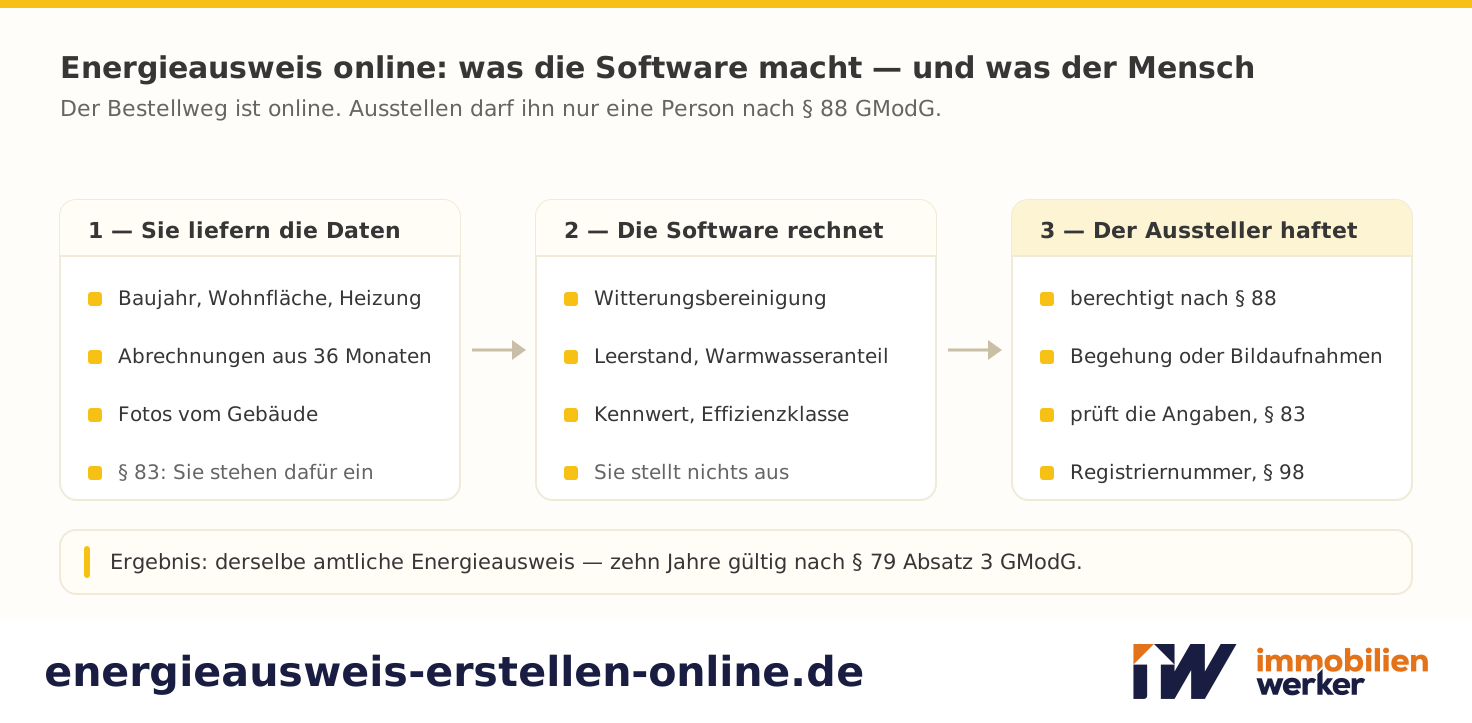
This division of labour is expressly provided for in the law. § 83 (1) GModG allows the issuer either to determine the data themselves or to use the data provided by the owner.3 That second variant is exactly the online route. It is not a loophole but the normal case — with one condition that appears two subsections later: under § 83 (3) GModG the issuer must check your details carefully and may not base their calculations on them if there are doubts about their accuracy.
- Person authorised to issue (ausstellungsberechtigte Person)
-
A person authorised to issue is someone listed by § 88 GModG in five groups — among them persons entitled to provide proof under building regulations law, graduates of certain degree programmes, craftspeople and chimney sweeps, state-certified technicians with a suitable specialisation, each with a training focus, two years of professional experience or training in energy-efficient construction. In addition, anyone who has passed the energy consulting qualification examination of the BAFA. Anyone without the authorisation may not issue an energy performance certificate.
So the software calculates, but it does not issue anything. It can form the key figure, apply the weather adjustment and assign the efficiency class — but a person authorised under § 88 GModG must sign,6 and their name, address and professional title appear in the certificate.5 Anyone who issues without this authorisation risks a fine of up to 10,000 euros under § 108 (1) no. 22 GModG.9 Who acquires the authorisation and how is covered in detail under who is allowed to issue an energy performance certificate.
Does anyone actually look at my house?
There is no energy performance certificate entirely without an inspection. § 84 (1) GModG obliges the issuer to inspect an existing building on site or to have suitable photographs of the building provided for an assessment of its energy characteristics.4 The two are equivalent — but one of them is required. That is precisely the difference between an online certificate and a certificate without any look at the building: the online route replaces the appointment with photos, it does not replace it with nothing.
That is why every proper online form asks for photos, and why a request for a better picture is not a sign of fussiness but of compliance. “Suitable” means: the pictures must show what the certificate makes a statement about — façade, windows, roof, the heat generator in the basement. A close-up of the front door is not enough for that.
And it is checked. The control body responsible under state law draws a sample from all energy performance certificates newly issued in a calendar year and checks the building data entered against the result; for this it may request a copy of the certificate and the documents used from the issuer.8 That is exactly why every issuer must keep both for two years. As long as the federal states have not taken over this task themselves, the German Institute for Building Technology (DIBt) performs it provisionally, for no more than five years (§ 114 GModG).16 The registration numbers are also allocated there.14
Which details to gather beforehand
The most common reason for an interrupted order is not the form but a missing folder. What you need depends on the certificate type; which one is permitted for your building is clarified in the comparison consumption or demand certificate.
Have ready for the consumption certificate
- Heating cost statements or supplier invoices covering 36 consecutive months
- the most recent billing period may not end more than 18 months ago
- periods and extent of vacancy over the whole period
- type of hot water preparation: central via the heating or decentralised via instantaneous water heaters
- living space and year of construction of the building as well as the year of construction of the heat generator
- postcode of the location — the climate factor for the weather adjustment is taken from it
These requirements are not in a provider’s small print but in § 82 (4) GModG.2 Three things about them are regularly underestimated.
The period must be continuous. A gap in the middle makes it unusable — the calculation then uses a different, gap-free window; nothing is filled in. Under the official federal interpretation it is expressly not permitted to estimate missing or excess consumption shares for a residential building and add or subtract them.11
Vacancy is a calculation variable, not a box to tick on a form. Longer vacancy exists from a vacancy factor of 0.05; the official procedure for taking it into account can only be applied up to a factor of 0.3, and the factor itself must be determined with a tolerance of no more than ± 10 per cent.12 If a house stood completely empty for years, the old statements can no longer support a consumption certificate.
The climate factor comes from the German Meteorological Service (Deutscher Wetterdienst, DWD), not from the provider. The DWD provides more than 8,200 location-based values for every delivery postcode free of charge, calculated for rolling twelve-month periods and, since May 2014, relative to the reference location Potsdam.13 It removes a cold winter from your consumption so that two buildings from different years remain comparable.
For the demand certificate the list is a different one: what counts there is not how the house was heated but how it is built.
| Detail | Consumption certificate | Demand certificate |
|---|---|---|
| Statements covering 36 months | yes | no |
| Vacancy periods | yes | no |
| Type of hot water preparation | yes | yes |
| Construction and thickness of the external walls | no | yes |
| Windows: type of glazing and year of installation | no | yes |
| Insulation of roof, basement ceiling, top floor ceiling | no | yes |
| Heat generator, year of construction, distribution and storage | roughly | precisely |
| Areas and geometry of the building | living space | building element areas |
One quantity stands out because it is not the one you have in mind: the calculation does not use the living space (Wohnfläche) but the usable floor area (Gebäudenutzfläche).
From living space to usable floor area
If the usable floor area is not known, it may be derived from the living space under § 82 (2) GModG2: for a residential building with up to two dwellings and a heated basement at 1.35 times the value, for all other residential buildings at 1.2 times.
140 m² × 1.35 = 189 m²
The same annual consumption therefore gives a noticeably lower figure per square metre than a calculation based on the living space would. Anyone who compares a rough online estimate with a certificate is therefore often comparing two different reference areas.
Result 140 m² living space ⇒ 189 m² usable floor area
How the order proceeds and how long it takes
The process is the same with every reputable provider, because the law maps it out: first data, then a check by a human being, then the registration number, then the certificate.
Effort on your side
From the form to the finished certificate
-
Get the documents ready
Statements, years of construction, areas — and photos of the building. With them to hand, you complete the form in one go.
the lion's share
-
Fill in the form
The form asks only for what the chosen certificate type needs and saves your progress as a draft. To the consumption certificate or to the demand certificate.
in one go
-
Check by the issuing person
They check your details for plausibility and may not use doubtful data (§ 83 (3) GModG). Queries are the rule here, not the exception.
nothing to do
-
Request the registration number
The issuer requests it electronically from the registration office and enters it in the certificate before handing it over (§ 85 (7), § 98 GModG).7
nothing to do
-
Collect the certificate
The finished certificate is available as a PDF in the customer portal and can be downloaded again there at any time.
nothing to do
The right-hand column describes your effort, not the processing time: the lion’s share of your time goes into gathering the documents; the form itself is then completed in one go. How long the check takes depends on whether queries are necessary — and they almost always arise from incomplete documents, not from the ordering route. A certificate that is ready in minutes without a single query has probably not gone through the check under § 83 (3) GModG.
What the certificate costs and how the price is made up is set out in detail under energy performance certificate costs. For orientation: at Energieausweis Portal the consumption certificate for a residential building costs 69.90 €, the demand certificate 119.90 €.
How to recognise a disreputable provider
There are three fields on the finished certificate that you can check without specialist knowledge — and together they answer the question of whether the document holds up.
| Field | Reference | What it proves |
|---|---|---|
| Registration number | § 85 (1) no. 4 | The certificate is registered with the registration office and can be drawn for a spot check |
| Data collected by | § 85 (1) no. 19 | Whether you or the issuer collected the data — and therefore who answers for what |
| Issuer and signature | § 85 (1) no. 20 | There is a nameable person with a professional title, not just a company |
Source: Own illustration based on § 85 (1) GModG
The fact that the second field exists at all is the strongest indication that the legislator knows and permits the online route: the certificate itself states who supplied the data. The division of responsibility in § 83 GModG is thus not concealed but printed.
Check before you order
-
Look for many reviews that can be verified — tied to an actual order and on an independent platform, not as freely submitted testimonials on the provider’s own site. What is meaningful is the volume over a longer period, not the average rating. Hundreds of mixed voices with a purchase behind them say more than a handful of enthusiastic ones of unknown origin.
-
The most important question of all. § 83 (3) sentence 2 GModG requires the issuer to check the data provided carefully and not to base their calculations on it if there are doubts about its accuracy.3 Anyone who accepts a form and generates a PDF from it without a single query does not fulfil this duty. A provider who never asks is not a particularly fast one but a disreputable one — and the consequences are borne by your certificate, not theirs.
-
The Verbraucherzentrale advises having it confirmed in writing before concluding the contract on what basis the person is personally authorised to issue — together with a description of services, confirmation of the data used, a data protection assurance and the number of the professional indemnity insurance.15
-
Are you asked for photographs? If not, a step required by § 84 (1) GModG is missing.
-
Under § 85 (4) GModG they are part of the certificate. If they are missing without explanation, that indicates the provider is not fully meeting their obligations.
-
Without it the certificate is incomplete. The issuer enters it before handing over the certificate.
-
Check what is included in the quoted price. A bait price at which registration or recommendations cost extra is not a good deal.
-
The obvious point to finish — an address for service and availability. Every provider on the market has a complete legal notice (Impressum); it only stands out when it is missing.
0 of 8 done Your ticks are saved in this browser — you can reload the page.
A second route leads via the energy efficiency expert list (Energieeffizienz-Expertenliste), the nationwide directory that the German Energy Agency (dena) maintains on behalf of federal ministries, BAFA and KfW and in which the qualifications of those listed are verified. The search is public and can be sorted by postcode. Anyone listed there may also submit applications in the federal funding programmes — an indication of verified qualification, not a prerequisite for the energy performance certificate.17
When the online route does not work
In six situations the form does not lead to the goal. That is not down to the technology but to the fact that the law requires a different certificate type, a site inspection or even two certificates.
| Case | What applies instead |
|---|---|
| Residential building with fewer than five flats, building application before 1 November 1977, not upgraded to the level of the Thermal Insulation Ordinance (Wärmeschutzverordnung) 1977 | demand certificate only; all three conditions must be met together 11 |
| Consumption data missing, incomplete or too old | demand certificate only — estimating missing shares is not permitted 11 |
| Complete vacancy over many years, vacancy factor above 0.3 | demand certificate only 12 |
| New building and cases of major alteration to the building | demand certificate under § 80 (1) and (2) GModG, calculated for the completed or altered building |
| Mixed-use building whose non-residential part differs substantially in use and technology and has a not insignificant share of the floor area | two separate certificates under § 106 GModG |
| Non-residential building with zoning, ventilation, cooling and built-in lighting | separate procedure, more data — see energy performance certificate for non-residential buildings |
Two of these rows change on 1 January 2027. The demand certificate requirement for small older buildings is dropped: for purely residential buildings there is then free choice between the certificate types. Conversely, it becomes stricter for non-residential buildings — for them a certificate based on an energy balance calculation must be issued in future, so a consumption certificate is no longer permitted.10
For the consumption certificate itself, several things shift as well: the recording period falls from 36 months to two years, the flat rate for decentralised hot water preparation from 20 to 16 kilowatt-hours per square metre and year, and normalisation is to the conditions of use under DIN/TS 18599-10.10 Both changes are in the wording of the amending Act of 28 July 2026; they only take effect at the turn of the year.
Frequently asked questions about the energy performance certificate from the web
Is an energy performance certificate issued online legally valid?
Yes, provided it is issued by a person authorised to issue under § 88 GModG and it carries a registration number. The ordering route is not a criterion in the law; the mandatory details and the validity of ten years are the same as for a certificate from an on-site appointment.
Does someone have to inspect my house?
The issuer must inspect an existing building on site or have suitable photographs provided (§ 84 (1) GModG). Photos therefore replace the appointment, but they cannot be dispensed with.
What happens if I made a mistake in one of the details?
You answer for the data you provide (§ 83 (3) GModG). The issuer must check it and may not use it if in doubt — which is why a query often comes at this point. Report an error before the certificate is issued.
How quickly does it work?
Your own effort lies almost entirely in gathering the documents; the form itself is then completed in one go. The processing time depends on whether queries become necessary. A certificate that appears within minutes without any check has skipped a step required by law.
How can I tell that the finished certificate is complete?
By three fields — the registration number, the detail of who collected the data, and the issuer with name, address, professional title, date of issue and signature (§ 85 (1) nos. 4, 19 and 20 GModG). The modernisation recommendations belong to it as well.
Does anyone actually check this?
Yes. The state control body draws a sample from the certificates newly issued in a calendar year and can request the certificate and the documents from the issuer (§ 99 GModG). Issuers must keep both for two years.
Conclusion: it is not the ordering route that matters, but who checks
An energy performance certificate issued online is the same official certificate — with the same registration number, the same mandatory details and the same ten years of validity. What carries it is not the interface but the person behind it: an issuer authorised under § 88 GModG who has seen the building or received photographs and has checked your details. So gather the documents before filling in the form, and afterwards check the three fields on the document. If a provider never asks a question, that is not service but a warning sign.
Sources
- Building Modernisation Act (GModG), § 79 — Principles of the energy performance certificate gesetze-im-internet.de ↩1 ↩2
- Building Modernisation Act (GModG), § 82 — Energy performance certificate based on recorded energy consumption gesetze-im-internet.de ↩1 ↩2 ↩3
- Building Modernisation Act (GModG), § 83 — Determination and provision of data gesetze-im-internet.de ↩1 ↩2
- Building Modernisation Act (GModG), § 84 — Recommendations for improving energy efficiency gesetze-im-internet.de ↩
- Building Modernisation Act (GModG), § 85 — Details in the energy performance certificate gesetze-im-internet.de ↩1 ↩2
- Building Modernisation Act (GModG), § 88 — Authorisation to issue energy performance certificates gesetze-im-internet.de ↩
- Building Modernisation Act (GModG), § 98 — Registration number gesetze-im-internet.de ↩
- Building Modernisation Act (GModG), § 99 — Spot checks of energy performance certificates gesetze-im-internet.de ↩1 ↩2
- Building Modernisation Act (GModG), § 108 — Provisions on fines gesetze-im-internet.de ↩1 ↩2 ↩3
- Act amending the Building Energy Act and further provisions in the heating sector, Federal Law Gazette 2026 I No. 226 of 28 July 2026 recht.bund.de ↩1 ↩2 ↩3 ↩4 ↩5
- Federal GModG portal — Frequently asked questions on the energy performance certificate (retrieved 02.09.2026) gmodg.bund.de ↩1 ↩2 ↩3
- Notice of the rules for energy consumption values in the existing residential building stock of 29 March 2021 (BAnz AT 16.04.2021 B1) gmodg.bund.de ↩1 ↩2
- German Meteorological Service (Deutscher Wetterdienst) — Climate factors for energy consumption certificates (retrieved 02.09.2026) dwd.de ↩
- German Institute for Building Technology (DIBt) — GEG registration office (retrieved 02.09.2026) dibt.de ↩
- Verbraucherzentrale — “So kommen Sie an einen Energieausweis für Ihre Immobilie” (retrieved 02.09.2026) verbraucherzentrale.de ↩
- Building Modernisation Act (GModG), § 114 — Provisional performance of the federal states' enforcement tasks by the German Institute for Building Technology gesetze-im-internet.de ↩
- Energy efficiency expert list for federal funding programmes, maintained by dena (retrieved 02.09.2026) energie-effizienz-experten.de ↩