Who is allowed to issue an energy performance certificate?

Christoph Werker Energieberater & Geschäftsführer
As of:
You are collecting quotes for an energy performance certificate (Energieausweis): one from the chimney sweep, one from an engineering firm, one from someone who calls themselves an energy consultant. This article is for owners facing that choice. Who is allowed to issue one at all is set out exhaustively in a single section of the Act — drawn both more narrowly and more widely than most people assume.

Five questions: who is authorised, how can you tell, what does the registration number say, may your chimney sweep do it, and what happens without authorisation.
Who is allowed to issue an energy performance certificate?
Authorised to issue is anyone who belongs to one of the five groups in § 88 (1) of the Building Modernisation Act (Gebäudemodernisierungsgesetz, GModG) and — for groups 2 to 4 — meets one of the three requirements of subsection (2).1 The list is exhaustive: anyone who falls into none of the groups may not issue — however much experience they have. When you need the certificate is covered in energy performance certificate duty; here the subject is the person who signs.
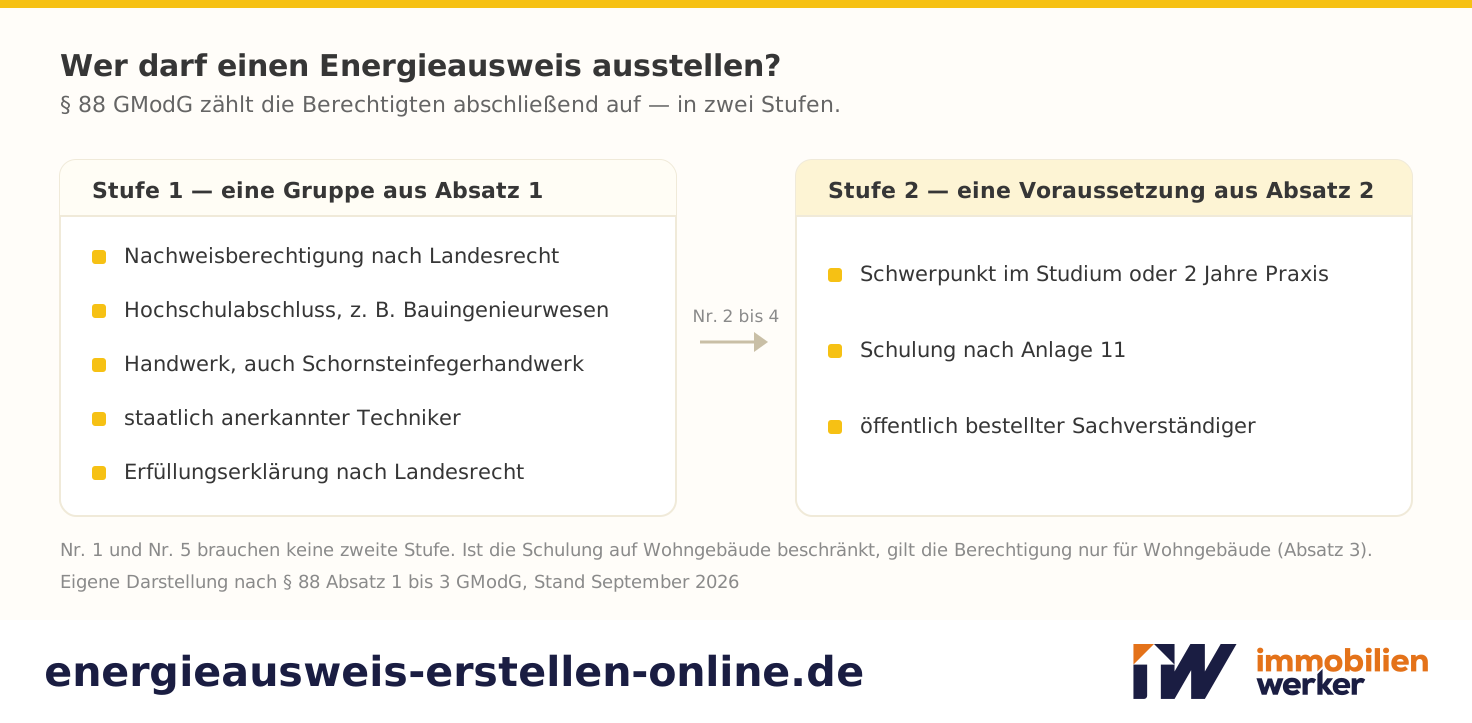
| Group | Who belongs to it | Subsection (2) |
|---|---|---|
| No. 1 Persons authorised to certify | anyone entitled under the state building code (Landesbauordnung) to sign structural thermal insulation certificates, within the scope of that entitlement | no |
| No. 2 University degree | architecture, interior architecture, building construction, civil engineering, building services engineering, physics, building physics, mechanical engineering, electrical engineering — or another technical discipline with a focus on one of these | yes |
| No. 3 Crafts | anyone who can be entered in the register of craftspeople (Handwerksrolle) for a licensed building, finishing or building-services trade or the chimney sweep trade; master craftspeople of unlicensed trades from these fields | yes |
| No. 4 Technicians | state-recognised or state-certified, with a focus on the building envelope, heating, hot water or ventilation and air conditioning | yes |
| No. 5 Compliance declaration | anyone permitted under state law to issue one (§ 92 GModG) | no |
- Authorisation to issue § 88 GModG
-
The authorisation to issue (Ausstellungsberechtigung) is the statutory permission to sign an energy performance certificate. It attaches to the person, not the company, and is not conferred: anyone who meets the criteria of § 88 GModG has it. No authority grants, checks or withdraws it.
Subsection (2) — one of these three requirements is added
Focus or two years
A training focus on energy-efficient building during the degree — or, without it, two years of professional experience in building construction afterwards.
Training under Annex 11
Successful completion of training under Annex 11 to the Act — from the inventory survey to the modernisation recommendations.
Sworn expert
Public appointment as a sworn expert for a field of energy-efficient building or building construction.
The first point is tied to a degree; for crafts and technicians, in practice, the training or the public appointment remain. The rule of thumb “two years of professional experience are always enough” is not correct.
Three routes complete the picture: anyone who has passed the energy consultancy qualification examination (Qualifikationsprüfung Energieberatung) of the Federal Office for Economic Affairs and Export Control is authorised under § 88 (5) GModG even without these core professions.1 Equivalent training from the EU, the EEA or Switzerland is treated as equal.8 And three grandfathered authorisations from 2007 continue to apply to existing residential buildings — two of them lose their basis on 1 January 2027.7
How can you tell that your issuer is authorised?
You cannot look it up; you have to ask. There is no official certificate of approval and no complete list of issuers; according to the consumer advice centre (Verbraucherzentrale), entries in provider directories are mostly based on unverified self-declarations.15
What belongs in a reputable quote
- Written statement of the basis on which the person is authorised — which group of § 88 GModG, which additional requirement
- Name of the person who signs; the authorisation attaches to them, not to the firm
- For a non-residential building: confirmation that the authorisation is not restricted to residential buildings
- Number of a professional liability insurance policy
- Written confirmation of the data you supplied
The restriction to residential buildings is the only limitation by building type: if the training was restricted to residential buildings, the authorisation applies only to them (§ 88 (3) GModG).1 By type of certificate the Act makes no distinction — anyone authorised is authorised for both; which one is permitted is decided by the building (consumption or demand certificate).
What the registration number says — and what it does not
Every energy performance certificate bears a registration number (Registriernummer). The issuer applies for it at the registration office, stating their name and address, the federal state and postcode of the building, the date of issue and the type of certificate and building (§ 98 GModG).4 Before handing the certificate over, they enter it; it is a mandatory detail just like their name, professional title and signature (§ 85 GModG).3 Where both appear is shown in the energy performance certificate template.
| Question | Answer |
|---|---|
| Certificate registered? | yes |
| Issuer authorised? | not checked |
Source: Own illustration based on § 98 GModG and information from the DIBt
Checks take place nonetheless: a random algorithm draws a sample with a fixed minimum share per certificate type, building type and federal state. Stage 1 runs purely electronically; stages 2 and 3 are carried out by the states’ inspection bodies — up to and including an on-site inspection.12 For this purpose the issuer keeps the documents for two years (§ 99 GModG).5
May my chimney sweep do it?
Yes, and not as an exception: § 88 (1) no. 3 letter a GModG names “the chimney sweep trade” on an equal footing with the licensed building, finishing and building-services trades.1 That fulfils only the first stage; as with every craft, subsection (2) must be added, usually the training under Annex 11. The Federal Association of the Chimney Sweep Trade cites more than 11,000 qualified energy consultants in the trade.16
Two roles should be kept apart: the fireplace inspection and the checks under § 97 GModG are carried out by the authorised district chimney sweep (bevollmächtigter Bezirksschornsteinfeger) as a sovereign task within the sweeping district. The energy performance certificate is independent of that — a free service, not tied to the district.
What happens if someone issues without authorisation?
Anyone who issues an energy performance certificate contrary to § 88 (1) GModG commits an administrative offence; § 108 (1) no. 22 provides for a fine of up to 10,000 euros.6 On 1 January 2027 the provision moves to no. 23, the amount stays the same — one of the changes of the Building Modernisation Act.9 It is the issuer who is penalised — you are not liable for their lack of authorisation, but you bear the risk: a document from an unauthorised person is not a proper energy performance certificate, and your duty to present one remains. Which other fines apply is set out under energy performance certificate fines.
The Act divides responsibility for the accuracy of the values: you answer for your data, the issuer for the data they determined themselves (§ 83 GModG).2 They must check your information carefully and may not rely on it if in doubt; both duties are subject to fines. From 1 January 2027 they must additionally walk through an existing building or have suitable photographs provided.9 If the certificate does not meet the requirements, you can demand free rectification and, after setting a deadline, withdraw from the contract.15
Frequently asked questions on the authorisation to issue
May I issue the energy performance certificate for my own house myself?
Only if you personally meet the requirements of § 88 GModG. The Act demands a qualification, not independence from the owner — anyone without it risks a fine of up to 10,000 euros.
Is it enough for someone to call themselves an energy consultant?
No. “Energy consultant” (Energieberater) is not a protected professional title and does not appear in § 88 GModG. Authorised is anyone who belongs to one of the five groups or has passed the energy consultancy qualification examination.
May craftspeople issue only consumption certificates?
No, that is a widespread misconception. The Act distinguishes the authorisation by residential and non-residential building (§ 88 (3)), not by type of certificate. Anyone authorised may issue both types.
Does the issuer have to visit my building?
Not necessarily until 31 December 2026; they may work with your data but must check it. From 1 January 2027 § 83 GModG requires a walk-through or suitable photographs for existing buildings.
Conclusion: ask about the basis, not the number
The authorisation to issue is regulated exhaustively and attaches to a person, not to a seal. Because there is neither a certificate of approval nor a public register, the written statement of the basis is your only reliable means of checking. The registration number does not replace it.
Sources
- Building Modernisation Act (GModG), § 88 — Authorisation to issue energy performance certificates gesetze-im-internet.de ↩1 ↩2 ↩3 ↩4 ↩5
- Building Modernisation Act (GModG), § 83 — Determination and provision of data gesetze-im-internet.de ↩
- Building Modernisation Act (GModG), § 85 — Details in the energy performance certificate gesetze-im-internet.de ↩
- Building Modernisation Act (GModG), § 98 — Registration number gesetze-im-internet.de ↩
- Building Modernisation Act (GModG), § 99 — Random checks of energy performance certificates gesetze-im-internet.de ↩
- Building Modernisation Act (GModG), § 108 — Provisions on fines gesetze-im-internet.de ↩1 ↩2
- Building Modernisation Act (GModG), § 113 — Transitional provisions for issuers of energy performance certificates gesetze-im-internet.de ↩
- Building Modernisation Act (GModG), § 77 — Expertise of inspection staff (applicable via § 88 (4)) gesetze-im-internet.de ↩
- Act amending the Building Energy Act and further provisions in the heating sector, Federal Law Gazette 2026 I No. 226 of 28 July 2026 recht.bund.de ↩1 ↩2
- German Institute for Building Technology, GEG registration office — Obtaining registration numbers (retrieved 09/2026) dibt.de ↩
- German Institute for Building Technology, GEG registration office — Energy performance certificates and air-conditioning inspection reports (retrieved 09/2026) dibt.de ↩
- German Institute for Building Technology, GEG registration office — Random checks (retrieved 09/2026) dibt.de ↩
- German Energy Agency (dena), rulebook of the Energy Efficiency Expert List for federal funding programmes, version of 16 June 2026 energie-effizienz-experten.de ↩
- German Energy Agency (dena), About the Energy Efficiency Expert List (retrieved 09/2026) energie-effizienz-experten.de ↩
- Verbraucherzentrale, “So kommen Sie an einen Energieausweis für Ihre Immobilie” (How to get an energy performance certificate for your property) (retrieved 09/2026) verbraucherzentrale.de ↩1 ↩2
- Federal Association of the Chimney Sweep Trade, Energieausweis (retrieved 09/2026) schornsteinfeger.de ↩1 ↩2
This article reflects the position at the time of publication and does not replace legal or energy advice in an individual case. Binding are the Building Modernisation Act (Gebäudemodernisierungsgesetz, GModG) in its applicable version and the details in the issued energy performance certificate.