Consumption or demand certificate
Energy performance certificate for non-residential buildings: duty, display and the 2027 turning point

Christine Werker Energieberaterin (EEE) & Architektin
As of:
If you own an office block, a medical practice, a heated workshop, a hotel or a school, different rules apply than for a residential building — and they are in different places in the Act. This article is written for owners and managers of such buildings. The most important difference first: besides sale and letting there is a second occasion — the duty to display the certificate publicly.

The article answers seven questions: what a non-residential building is, when the certificate duty arises, when you have to display it, which certificate type is permitted and what data it needs, what it costs, what changes in 2027 — and which buildings fall outside altogether.
What is a non-residential building — and when is yours one?
The Act does not define the term positively but by subtraction — what is checked is the other side.
- Non-residential building (Nichtwohngebäude)
-
Under § 3 (1) no. 23 of the Building Modernisation Act (Gebäudemodernisierungsgesetz), a non-residential building is any building that is not a residential building. Under no. 33, a residential building is a building that according to its intended purpose is mainly used for living — residential homes, retirement homes and care homes included. Everything else is a non-residential building: office, practice, shop, hotel, school, workshop.
What matters is the intended purpose, not the ownership structure — a block of flats owned by a limited company (GmbH) remains a residential building.
The second difference is the reference area, and it runs through every figure: for a residential building the Act calculates with the usable floor area (Gebäudenutzfläche), for a non-residential building with the net floor area (Nettogrundfläche) — both under DIN V 18599, in each case the heated or cooled part (§ 3 (1) no. 10 and 22 GModG).2 A figure in kilowatt-hours per square metre is therefore not comparable between a residential building and an office block. How it is arrived at is explained in the overview of the energy performance certificate.
| Feature | Residential building | Non-residential building |
|---|---|---|
| Reference area | usable floor area | net floor area |
| Energy recorded in the consumption certificate | heating and hot water | additionally cooling, ventilation, lighting |
| Figure in the certificate | one figure | heat and electricity separately |
| Efficiency class (as of 2026) | A+ to H | none |
| Duty to display | no | yes, where there is heavy public traffic |
| Demand certificate compulsory for older buildings before 1977 | yes, below five flats | no |
The case where most people go wrong: mixed-use buildings
The residential building with the doctor’s practice on the ground floor, the office building with the caretaker’s flat: here it is not the predominant use that decides. § 106 GModG requires the deviating part to be treated separately, and § 79 (2) sentence 2 turns this into two certificates for the same building.8
The separation does not apply automatically but requires three things:
When a part of a building must be treated separately (§ 106 (1) GModG)
- The type of use differs substantially from residential use
- So does the building services equipment — its own ventilation, cooling, its own heat generator
- The part covers a not insignificant share of the usable floor area
Subsection 2 mirrors the rule: residential parts in a non-residential building are treated separately as a residential building as soon as they make up a not insignificant share of the net floor area.
This provision has an expiry date. On 1 January 2027 § 106 is replaced by “Solar energy in buildings”, and § 79 (2) sentence 2 — the provision that orders the certificate for parts of buildings — is also dropped.10 What takes its place is not separate treatment but zoning within the same certificate: under the new § 20 (2), a residential building with not insignificant parts of its area that are used substantially differently and equipped differently is “to be divided into zones”. Two certificates become one with two zones. For the reverse case — residential parts in a non-residential building, today § 106 (2) — the amending Act names no successor provision; this question is open.
When do you need an energy performance certificate for a non-residential building?
It is not ownership that creates the duty but the occasion — § 80 GModG lists four.4
The four occasions for a non-residential building
New building
After completion, a demand certificate without undue delay (§ 80 (1) GModG).
Major alteration
Alterations within the meaning of § 36 with a calculation for the entire building — a new demand certificate is then due and the old one loses its validity (§ 80 (2)).
Sale, letting, leasing, leasing arrangements
Also the creation or transfer of a heritable building right (§ 80 (3) sentence 1).
Duty to display
The only occasion without a transaction — where there is heavy public traffic (§ 80 (6) and (7)).
The Act distinguishes two acts here: presenting means showing, handing over means giving. The certificate must be presented unprompted at the latest at the viewing and handed over without undue delay after the contract is concluded (§ 80 (4) sentences 1 to 5, for letting via subsection 5). It must therefore be ready before the first viewing, not before the notary appointment. The deadlines are set out under energy performance certificate duty.
One detail of the property advertisement is almost always overlooked. § 87 (1) requires five mandatory details as soon as a certificate exists — year of construction and efficiency class only for residential buildings. In return, subsection 2 is added: for a non-residential building the final energy demand or consumption must be stated separately for heat and for electricity.7 So the advertisement contains two figures. If they are missing, that is a regulatory offence (§ 108 (1) no. 21 GModG, from 2027 no. 22) — and a risk of a formal warning letter.
When do you have to display the energy performance certificate?
This duty exists only for non-residential buildings, in two subsections with different thresholds. More important than the figure is the scope: subsection 6 requires the certificate to be issued in the first place, subsection 7 only requires an existing one to be displayed.
| Criterion | § 80 (6) — public-authority use | § 80 (7) — without public-authority use |
|---|---|---|
| Threshold | more than 250 m² of usable area | more than 500 m² of usable area |
| Additional condition | heavy public traffic from public-authority use | heavy public traffic |
| Issuing | mandatory, even without a sale | none — only if a certificate exists |
| Who displays it | the user, otherwise the owner | the user, otherwise the owner |
| What is sufficient | extract following the official template | extract following the official template |
It is displayed “at a place clearly visible to the public” (§ 80 (6) sentence 2 GModG) — in practice the entrance area, foyer or reception. The Act names no room but a result: anyone who enters the building sees the certificate without having to look for it.
Two finer points decide who has to act:
- If the space is let, the tenant displays it. If the owner does not mainly use it themselves, the duty falls on the user; the owner must hand them the certificate or a copy (§ 80 (6) sentences 3 and 4).
- An extract following the official template is sufficient, not the whole certificate (sentence 5).
Consumption or demand certificate — and what data does it need?
For a non-residential building you currently have a free choice. The reason is in § 80 (3) sentence 2 GModG: the duty to obtain a demand certificate for small, unrenovated older buildings with a building application before 1 November 1977 applies only to residential buildings with fewer than five flats.4 For an office block from 1962 it does not exist. The difference between the two types is set out in the comparison consumption or demand certificate.
The data requirement is broader here, and that is the key practical difference: what is recorded is heating, hot water, cooling, ventilation and the built-in lighting, in kilowatt-hours per year and square metre of net floor area (§ 82 (2) sentence 5 GModG).5 For a residential building electricity stays out. So you need electricity bills in addition to the heating bills.
What to have ready for the consumption certificate
- Heating bills covering 36 consecutive months; at the end, the most recent billing period may not be more than 18 months old
- Electricity bills for the same period
- Net floor area of the heated or cooled area
- Year of construction of the building and of the heat generator
- Details of longer vacancies during the recording period
- Main use or building category, with area shares where there are several uses
Two calculation steps are added. The heating consumption is weather-adjusted — via the prescribed climate factors of the German Weather Service (Deutscher Wetterdienst) to the standard location of Potsdam.12 And longer vacancies must be taken into account appropriately in the calculation (§ 82 (4) sentence 3), otherwise a half-empty office block would look more efficient than it is. A separate notice of 15 April 2021 applies to this, with rules on electricity consumption, cooling generation and the comparison values.12
The demand certificate is considerably more complex here, and the reason is in § 85 (2): it requires zoning — building zones with net floor area and share, and the breakdown of the final energy demand into heating, hot water, lighting, ventilation and cooling.6 A building with sales, storage, office and staff rooms is broken down and each zone is balanced individually.
Of the two types, the consumption certificate for non-residential buildings can be ordered at Energieausweis Portal; we do not offer a demand certificate for non-residential buildings. The route is via the form for the consumption certificate and the choice of building type.
What does an energy performance certificate for a non-residential building cost?
The consumption certificate for a non-residential building costs 39.99 € at Energieausweis Portal. What it includes and which additional services there are is set out under energy performance certificate costs.
For the demand certificate there is no meaningful flat price, and that is down to the zoning: the effort depends on the number of use zones, the building services and the building documents. We do not quote other providers’ prices — there are no reliable market figures on this from official or technically authoritative sources.
Order a consumption certificate for a non-residential building
Enter heat and electricity data from 36 months, checked by certified issuers, certificate as a PDF in the customer portal.
What changes on 1 January 2027 — and afterwards?
The Building Modernisation Act has applied since 29 July 2026; its energy performance certificate parts, however, only enter into force on 1 January 2027 (Article 2 of the amending Act, Federal Law Gazette 2026 I No. 226).10 For non-residential buildings this is the bigger of the two changes — five points count.
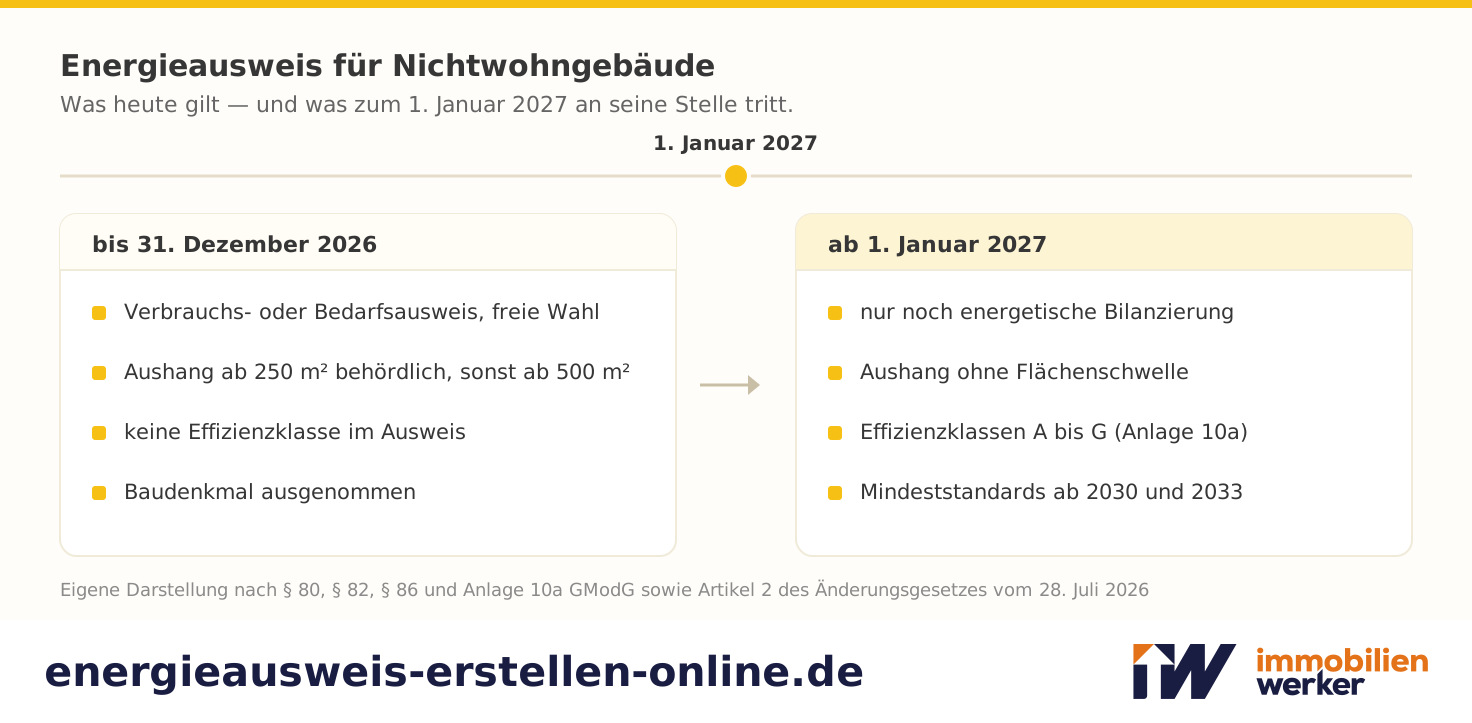
First: the consumption certificate is dropped. § 80 (3) sentence 2 in the new version prescribes for non-residential buildings a certificate “on the basis of an energy balance under § 81” — that is, a demand certificate. The BBSR puts it the same way: no more energy consumption certificates for non-residential buildings.11 Anyone who wants one has it issued in 2026; it remains valid for ten years, and § 112 in the new version governs advertising with it.
Second: the area thresholds for display are dropped. For an existing non-residential building owned by the public sector in public-authority use, a certificate must in future be issued without a square-metre limit; it is displayed where there is heavy public traffic. A non-residential building not in public-authority use displays the certificate “as soon as and as long as an energy performance certificate exists for the building” — the 500 square metres no longer appear there.
Third: non-residential buildings get efficiency classes. Until the end of 2026 their certificate carries none; § 86 in the current version knows them only for residential buildings. From 2027 the EU-wide uniform scale A to G under the new Annex 10a applies — only to non-residential buildings; homes keep A+ to H. Unlike there, it is not a kilowatt-hour value but a ratio: calculated primary energy demand divided by that of the reference building.
Energy efficiency classes of non-residential buildings from 2027 (Annex 10a GModG)
- A ratio ≤ 1.0
- B above 1.0
- C above 1.48
- D above 1.97
- E above 2.46
- F above 2.95
- G above 3.5 highlighted
Only zero-emission buildings may be placed in class A — buildings without emissions from fossil energy on site. What the scale means and why it does not affect homes is set out under energy efficiency classes A to G for non-residential buildings.
Fourth: minimum standards from 2030 and 2033. In Article 9 (1), the EU Energy Performance of Buildings Directive requires all non-residential buildings to be below the 16 per cent threshold of the national stock from 2030 and below the 26 per cent threshold from 2033.13 Unlike for residential buildings, where the Directive only requires an average, the check here is building by building. Germany implements this in § 40 GModG, which is reworded on 1 January 2027 — today the number bears the note “(repealed)”. After that, the annual primary energy demand may be at most 3.5 times that of the reference building from 2030 and at most 2.95 times from 2033.
These two figures are exactly the lower limits of classes G and F from Annex 10a:
| Key date | Maximum annual primary energy demand | No longer permitted then |
|---|---|---|
| 1 January 2030 | 3.5 times that of the reference building | G |
| 1 January 2033 | 2.95 times that of the reference building | F and G |
Source: Own illustration based on Annex 10a and § 40 (2) GModG, each in the version applicable from 2027
Fifth — and this takes the edge off point four for most buildings: § 40 (3) declares the requirement met without any calculation if one of four conditions applies.
When the minimum standards are deemed to be met (§ 40 (3) GModG from 2027)
- Built on or after 1 January 1996
- Built before 1996 but demonstrably brought up to the level of the Thermal Insulation Ordinance (Wärmeschutzverordnung) of 1994
- The heating generates its heat mainly with biomass or a heat pump
- The building is supplied with district heating
Added to these are the exemptions in subsection 4 — demolition, abandonment of the business premises, change of use, comprehensive renovation, listed building, industrial plant, workshop or agricultural building with low energy demand, free-standing small building. And subsection 1 sentence 2 exempts “insofar as compliance is technically impossible or economically unreasonable”. The proof is governed by § 41, which is also reworded — more on this under minimum standards for non-residential buildings.
Which buildings fall outside the Act altogether?
Some buildings do not need an energy performance certificate because the Act does not cover them at all. § 2 (1) applies to buildings “insofar as, according to their intended purpose, they are heated or cooled using energy”; subsection 2 names nine cases in which it does not apply.1
| Case | Provision and condition |
|---|---|
| Animal husbandry | no. 1 — mainly used for rearing or keeping animals |
| Open operational buildings | no. 2 — to be kept open over large areas and for long periods |
| Underground structures, air-supported halls and tents | no. 3 and no. 5 |
| Greenhouses | no. 4 — glasshouses and cultivation rooms for plants |
| Mobile and temporary buildings | no. 6 — demountable or used for up to two years |
| Religious buildings | no. 7 — dedicated to worship |
| Barely heated operational buildings | no. 9 — below 12 °C or heated for less than four months and cooled for less than two months |
| Small building | § 79 (4) sentence 1, § 3 (1) no. 17 — at most 50 m² of usable area | | Listed building | § 79 (4) sentence 2 — exempt from § 80 (3) to (7), only until 31 December 2026 |
These exemptions are not a marginal case: according to the ENOB:dataNWG survey by the Institut Wohnen und Umwelt, there are around 21.1 million non-residential buildings in Germany, but only around 1.98 million fall fully under § 2 (1).14 The rest are garages, sheds and other unheated structures.
Frequently asked questions about the energy performance certificate for non-residential buildings
Do I need a separate energy performance certificate for a let commercial unit?
No. The certificate is issued for the building, not for the unit (§ 79 (2) GModG). Only for parts of a building that must be treated separately under § 106 are there two certificates.
Do I have to display the energy performance certificate in my shop?
Only where there is heavy public traffic and more than 500 square metres of usable area, and only if a certificate exists anyway (§ 80 (7) GModG). You do not have to have one issued for this. From 2027 the threshold is dropped.
Why does the advertisement for an office block show a figure twice?
Because § 87 (2) GModG requires the final energy demand or consumption for non-residential buildings to be stated separately for heat and electricity. For a residential building one is enough.
Is a consumption certificate still worthwhile for a non-residential building?
Until 31 December 2026 yes, if heat and electricity bills from 36 consecutive months are available. It remains valid for ten years. From 2027 the Act only provides for the energy balance.
Do I have to renovate my commercial property because of the new minimum standards?
Only if none of the four conditions for compliance applies that § 40 (3) GModG provides from 2027 — year of construction from 1996, level of the 1994 Thermal Insulation Ordinance, heat pump or biomass, and district heating.
Does the duty to display also apply to a residential building with a doctor's practice?
Only for the practice part, and only if it is to be treated separately as a non-residential building under § 106 GModG and reaches the thresholds of § 80 (6) or (7). From 2027 zoning within the same certificate replaces the separate treatment.
Conclusion: the choice of certificate has an expiry date
The same occasions apply to a non-residential building as to a residential building, plus the duty to display — and the certificate records electricity in addition to heat. As long as bills from 36 consecutive months are available, the consumption certificate is the quicker route. From 1 January 2027 this choice no longer exists: the Act then requires the energy balance, introduces the classes A to G and starts with minimum standards, from which many buildings remain exempt by year of construction.
Sources
- Building Modernisation Act (GModG), § 2 — Scope (as of 08/2026) gesetze-im-internet.de ↩
- Building Modernisation Act (GModG), § 3 — Definitions (as of 08/2026) gesetze-im-internet.de ↩
- Building Modernisation Act (GModG), § 79 — Principles of the energy performance certificate (as of 08/2026) gesetze-im-internet.de
- Building Modernisation Act (GModG), § 80 — Issuing and use of energy performance certificates (as of 08/2026) gesetze-im-internet.de ↩1 ↩2
- Building Modernisation Act (GModG), § 82 — Energy consumption certificate (as of 08/2026) gesetze-im-internet.de ↩1 ↩2
- Building Modernisation Act (GModG), § 85 — Details in the energy performance certificate (as of 08/2026) gesetze-im-internet.de ↩
- Building Modernisation Act (GModG), § 87 — Mandatory details in a property advertisement (as of 08/2026) gesetze-im-internet.de ↩
- Building Modernisation Act (GModG), § 106 — Mixed-use buildings (as of 08/2026) gesetze-im-internet.de ↩
- Building Modernisation Act (GModG), § 108 — Provisions on fines (as of 08/2026) gesetze-im-internet.de ↩1 ↩2
- Act amending the Building Energy Act and further provisions in the heating sector, Federal Law Gazette 2026 I No. 226 of 28 July 2026 — Article 2 enters into force on 1 January 2027 recht.bund.de ↩1 ↩2
- BBSR, GModG information portal — New rules under the Building Modernisation Act (retrieved 2 September 2026) gmodg.bund.de ↩
- BBSR, GModG information portal — Notices on consumption certificates and climate factors of the German Weather Service (retrieved 2 September 2026) gmodg.bund.de ↩1 ↩2
- Directive (EU) 2024/1275 on the energy performance of buildings, Articles 9 and 19 (Official Journal of 8 May 2024) eur-lex.europa.eu ↩
- Institut Wohnen und Umwelt, ENOB:dataNWG — Overall structure of the German non-residential building stock, Bischof, Hörner and Rodenfels, 28 November 2024 datanwg.de ↩1 ↩2
This article reflects the position at the time of publication and does not replace legal or energy advice in an individual case. Binding are the Building Modernisation Act (Gebäudemodernisierungsgesetz, GModG) in its applicable version and the details in the issued energy performance certificate.