Consumption or demand certificate
Energy performance certificate template: all five pages explained

Christoph Werker Energieberater & Geschäftsführer
As of:
In front of you lies an energy performance certificate, and few of the fields on it explain themselves: two scales, several figures with the same unit, a cross in a place nobody comments on. This article is written for owners of a residential building who want to read and make sense of an issued document — before a sale, before a new letting, or because the certificate has just arrived in the post.

We go through the form as it lies in front of you: page by page, each with the official template as an illustration. At the end come the template for non-residential buildings, the details for the property advertisement and what changes on 1 January 2027.
How the official template is structured
What an energy performance certificate (Energieausweis) has to look like is not stated in the Act itself. The Building Modernisation Act (Gebäudemodernisierungsgesetz, GModG) lists in § 85 which details it must contain;1 the forms for it are published in the Federal Gazette (Bundesanzeiger) by the Federal Ministry for Economic Affairs and the Federal Ministry for Building, as § 85 (8) GModG prescribes. The notice of 1 December 2023 is authoritative.9 Anyone who issues a certificate must use this template; there is no design of one’s own.
Four forms have been published: a five-page certificate each for residential buildings and for non-residential buildings, plus two single-page display templates. The display templates exist only for non-residential buildings, because the duty to display under § 80 (6) and (7) GModG is tied to usable floor areas with heavy public traffic.7
| Page | What is on it | When it counts |
|---|---|---|
| 1 | General details on the building, validity, registration number, issuer | always |
| 2 | Details based on the calculated demand | decisive for the demand certificate |
| 3 | Details based on the recorded consumption | decisive for the consumption certificate |
| 4 | Issuer’s recommendations | always, provided measures are possible |
| 5 | Explanations of methods and terms | always |
The last column is what matters: a demand certificate (Bedarfsausweis) carries its decisive figures on page 2, a consumption certificate (Verbrauchsausweis) on page 3; the other page as a rule stays blank. It is not excluded, though — § 79 (1) GModG expressly permits stating both demand and consumption,2 and the form itself describes additional consumption details on a demand certificate as voluntary. Which of the two types is permitted for your building is clarified in consumption or demand certificate — here the subject is reading the finished document.
Official template: energy performance certificate for residential buildings
All five pages as a blank form, as published in the notice of 1 December 2023. Official work, free to use.
Official template: energy performance certificate for non-residential buildings
The same structure for commercial and administrative buildings, with separate values for heat and electricity.
Page 1: validity, registration number and the reference area
The cover page — shown in the following illustration — carries the details that apply to every certificate, regardless of the method. § 85 (1) GModG lists them individually.1 Seven of them are regularly looked for.

The field “Gültig bis” (valid until) is at the very top left. An energy performance certificate is issued for ten years (§ 79 (3) GModG),2 but loses its validity early if a new demand certificate has to be issued for an altered building under § 80 (2) GModG — which is the case when, on an alteration of external building elements, the whole building is recalculated.
The registration number is assigned by the registration office: the issuer applies for it under § 98 GModG and enters it before handing the certificate over.13 In practice it begins with the federal state code and the year of issue, for example “BE-2026-” followed by a sequential number. It is a reference number, not a quality seal.
Two years of construction are listed one below the other: that of the building and that of the heat generator, or for district or local heating that of the transfer station. Anyone who reads only the first figure overlooks the second, which matters more for heating costs.
The usable floor area (AN) is the reference quantity for all figures, and next to it is a box “aus der Wohnfläche ermittelt” (derived from the living space). If it is ticked, the area was not measured but extrapolated.
- Usable floor area (Gebäudenutzfläche)
-
The usable floor area is the area to which all figures of a residential energy performance certificate relate — every value in kilowatt-hours per square metre and year means this square metre. If it is not known, it may be extrapolated from the living space (Wohnfläche) under § 82 (2) GModG: at 1.35 times for up to two dwellings with a heated basement, otherwise at 1.2 times.11 It is therefore usually larger than the living space — the same consumption produces a lower figure on it.
The certificate type is ticked in the box “Hinweise zu den Angaben über die energetische Qualität” (notes on the details of the energy quality), and the cross also tells you which of the two following pages is completed. The line “Datenerhebung Bedarf/Verbrauch durch” (demand/consumption data collected by) records whether the owner or the issuer collected the data; for certificates produced online it is as a rule the owner. That is not a formality: under § 83 (3) GModG, whoever provides the data must ensure that it is correct.12 The issuer is named below, with date of issue and signature.
Every complete energy performance certificate has these five features
- A registration number, in practice with the federal state code and year of issue
- A named issuer with address, professional title and signature
- A date of issue and a “Gültig bis” (valid until) that are ten years apart
- All five pages of the official template, including the figures page that is not completed
- The statement of who collected the data: owner or issuer
What issuing costs and where the price ranges come from is set out in what an energy performance certificate costs.
Have your energy performance certificate issued online
If one of these features is missing or the “valid until” date has been reached, you need a new certificate before a sale or new letting: consumption certificate 69.90 €, demand certificate 119.90 €, checked by certified issuers and as a PDF in the customer portal.
Page 2: the calculated energy demand
This page carries the figures of the demand certificate. Its core is the colour band from A+ to H with two arrows: the arrow above the band shows the final energy demand, the arrow below it the primary energy demand. Only the upper one determines the efficiency class — and only it is repeated further down in its own line “Endenergiebedarf dieses Gebäudes [Pflichtangabe in Immobilienanzeigen]” (final energy demand of this building [mandatory detail in property advertisements]).

Below on the left is the block “Anforderungen gemäß GEG” (requirements under the GEG) with actual and required value — to be completed only for a new building or a modernisation in the case of § 80 (2). In the ordinary certificate for an existing building it stays blank, and that is not an error. To the right of it is ticked which calculation method was used, and at the bottom right are the comparison values: a second, smaller scale with markers from “Effizienzhaus 40” (efficiency house 40) to “EFH energetisch nicht wesentlich modernisiert” (detached house not significantly modernised in energy terms).
Page 3: the recorded energy consumption
For the consumption certificate the decisive value is here instead. At the top sits the same colour band, only here the arrows are called final energy and primary energy consumption; below follows again the line with the mandatory detail for property advertisements.
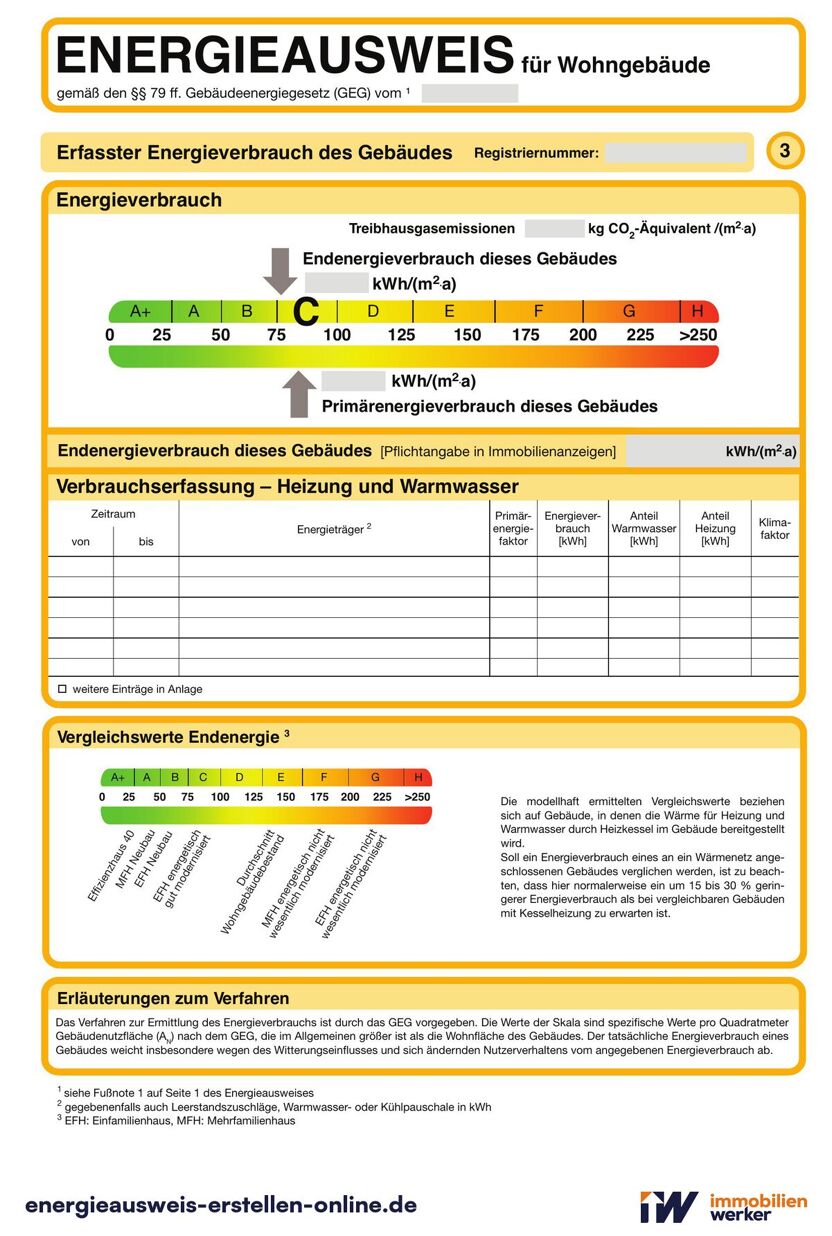
Below that is what makes the consumption certificate: the consumption record shows each period used with energy source, primary energy factor, consumption in kilowatt-hours, the share for hot water and heating, and the climate factor, which converts the location to a nationwide reference climate. Footnote 2 names what else may be contained in these lines: vacancy surcharges as well as flat-rate allowances for hot water and cooling. Both flat rates are the reason why a figure can be higher than your own bill: if, with decentralised hot water generation, the hot water share is not known, § 82 (2) GModG adds 20 kilowatt-hours per square metre and year, and for cooled areas a further 6.11
The three figures on pages 2 and 3
Three figures with similar names sit close together, and only the first is the one asked for in practice.
| Feature | Final energy | Primary energy | Greenhouse gas |
|---|---|---|---|
| What it describes | What arrives at the building | Additionally the upstream chain of the energy source | The emissions from operation |
| Unit | kWh/(m²·a) | kWh/(m²·a) | kg CO₂ equivalent/(m²·a) |
| Decisive for | Efficiency class and advertisement | Requirements for new build and renovation | Assessing the climate impact |
| Origin of the figure | Calculation or bill | Final energy times primary energy factor | Emission factors of Annex 9 |
Final energy is the quantity that has to be delivered: gas at the meter, oil in the tank, pellets in the store. It determines the efficiency class, belongs in the advertisement and is the only one of the three from which heating costs can be estimated.
Primary energy adds extraction, conversion and transport. The factor for it depends on the energy source: grid electricity counts today at 1.8, heating oil and natural gas at 1.1, electricity generated close to the building from photovoltaics or wind power at 0.0.8 On 1 January 2027 the factor for grid electricity falls to 1.5 — the same installation, a different value.10
The greenhouse gas emissions in kilograms of carbon dioxide equivalent per square metre and year are shown at the top right above the colour band. They are calculated from the energy figures using the emission factors of Annex 9 to the GModG, not measured.14
What the efficiency class on the band means
The class is not an independent rating but a derivation: under § 86 (2) GModG it follows “directly from the final energy consumption or final energy demand”.3 Both certificate types use the same scale; the limits are in Annex 10 to the Act.4
Energy efficiency classes of residential buildings under Annex 10 to the GModG
- A+ up to 30 kWh/(m²·a)
- A up to 50 kWh/(m²·a)
- B up to 75 kWh/(m²·a)
- C up to 100 kWh/(m²·a)
- D up to 130 kWh/(m²·a) highlighted
- E up to 160 kWh/(m²·a)
- F up to 200 kWh/(m²·a)
- G up to 250 kWh/(m²·a)
- H above 250 kWh/(m²·a)
The limits are worded as “less than or equal to”, and that decides borderline cases: a building with exactly 100 kilowatt-hours per square metre and year is still class C; only a value above that makes it D.
Which building condition lies behind a class is not stated in the Act — the following assignment is a classification from issuing practice and not a legal definition.
| Class | Typical building condition |
|---|---|
| A+ and A | New building to current standard, some with their own generation |
| B and C | good new building or comprehensively modernised existing building |
| D | partly modernised, for example new windows with an uninsulated façade |
| E | older stock with individual measures |
| F to H | largely unrenovated old building, H with high losses |
Page 4: the modernisation recommendations
Page 4 begins with a cross at “möglich” (possible) or “nicht möglich” (not possible) — because under § 84 GModG the recommendations are a mandatory component unless the technical assessment shows that measures are not possible; in that case exactly this has to be noted.6

Each line names a building or plant component, the measure and two boxes: recommended as an individual measure or as part of a larger modernisation. The last two columns — payback period and cost per kilowatt-hour saved — are voluntary and therefore often blank. For this assessment the issuer must inspect the building on site or have suitable photographs made available. The form marks out its own scope: brief pointers, no substitute for energy advice.
Page 5: the explanations
The last page explains the terms of the previous pages, and each entry carries the page number in its title: part of the building and renewable energies for page 1, energy demand, primary energy demand and energy quality of the building envelope for page 2, final energy and primary energy consumption for page 3, plus greenhouse gas emissions, mandatory details for property advertisements and comparison values for both figures pages.

Two passages are worth reading. On the consumption certificate the page states that drawing a conclusion about the consumption to be expected in future is not possible — the consumption of individual flats depends on location, use and occupants. And it calls the comparison values model reference points for rough comparisons, not requirement values.
The much-quoted sentence on the reference area, by contrast, is not here but in the explanation boxes on pages 2 and 3: the values shown apply per square metre of usable floor area, which is generally larger than the living space. Anyone who multiplies the figure by their living space therefore regularly calculates too low.
The template for non-residential buildings
By its wording, § 86 GModG applies to residential buildings.3 The template for non-residential buildings therefore carries no letter class but a continuous scale of primary energy demand from 0 to over 1,000 kilowatt-hours per square metre and year, on which two arrows mark the requirement values for new buildings and modernised old buildings.

In return there is more on it: the final energy demand is broken down by heating, hot water, built-in lighting, ventilation and cooling, heat and electricity each have their own mandatory-detail line, and the building zones appear with area and share.1
Non-residential buildings are also the only ones with a duty to display. Under § 80 (6) GModG it applies to more than 250 square metres of usable floor area with heavy public traffic from public-authority use and under paragraph (7) to more than 500 square metres without public-authority use.7 What is displayed is then not the whole certificate but the single-page display template.
From 1 January 2027 non-residential buildings also receive classes — but on a scale that measures something else.
| Class | Primary energy reference factor |
|---|---|
| A | ≤ 1.0 — only for zero-emission buildings |
| B | > 1.0 |
| C | > 1.48 |
| D | > 1.97 |
| E | > 2.46 |
| F | > 2.95 |
| G | > 3.5 |
The value is the ratio of the calculated primary energy demand to that of a reference building, not a consumption per square metre.10 From 2027 a “C” on a commercial certificate and a “C” on a residential certificate say two different things.
Which details from the certificate belong in the property advertisement
As soon as an energy performance certificate exists and a commercial property advertisement is placed, § 87 (1) GModG requires five details from it.5 When a duty to have a certificate arises at all and what you risk without one is set out in when an energy performance certificate is mandatory. They are all in the document, spread over the first three pages.
| Mandatory detail | Where it is in the certificate |
|---|---|
| Type of certificate: demand or consumption certificate | Page 1, ticked |
| Final energy demand or final energy consumption | Page 2 or page 3, in its own mandatory-detail line |
| Main energy sources of the heating | Page 1 |
| Year of construction of the building, for residential buildings | Page 1 |
| Energy efficiency class, for residential buildings | Page 2 or page 3, on the colour band |
For a non-residential building the single value is replaced by a pair: final energy for heat and for electricity, listed separately. The date of issue is not part of it today.
From 1 January 2027 the list is rebuilt, and more markedly than it appears at first glance: the date of issue is added, and instead of the final energy the annual primary energy demand per square metre of usable floor area then has to be stated.10 For certificates issued before 1 January 2027, on the other hand, the previous list remains — including in advertisements placed later.
What changes on the template on 1 January 2027
The amendment that turned the Building Energy Act (Gebäudeenergiegesetz) into the Building Modernisation Act was promulgated in the Federal Law Gazette on 28 July 2026. The changes to the energy performance certificate are in its Article 2 and enter into force on 1 January 2027 under Article 9 (2).10 The new § 85 lists 31 details, and several of them are not on today’s form.
| Detail | Until 31.12.2026 | From 1.1.2027 |
|---|---|---|
| Figures per square metre | yes | yes |
| Absolute annual value in megawatt-hours | no | mandatory |
| Share of renewable generation on site | no | mandatory, in per cent |
| Response to external signals | no | mandatory, as a yes-or-no detail |
| Suitability for low flow temperatures | no | mandatory, as a yes-or-no detail |
| Comparison values next to the scale | yes | dropped |
| Value in the property advertisement | final energy | annual primary energy demand |
| Efficiency class for non-residential buildings | no | Annex 10a |
| Form of the certificate | paper or digital | digital and machine-readable, paper on request |
Page 4 is also upgraded: the recommendations must then estimate the energy saving and the emission reduction and assess whether the building services can run at more efficient temperatures and how long they will last. For class A they are dropped.
One practical point is still missing: the new form does not exist yet. The authorisation to publish is in the Act; the templates will be released as soon as they appear in the Federal Gazette.9 Until then the 2023 form continues to apply — recognisable by the fact that its header still reads “Gebäudeenergiegesetz (GEG)” (Building Energy Act) and not the new title of the Act.
Frequently asked questions on the template and reading the certificate
How do I recognise that an energy performance certificate is complete?
By four things: a registration number, a named issuer with address, professional title and signature, all five pages of the official template, and a date of issue no more than ten years ago. The registration number proves the registration, not the correctness of the details — under § 83 (3) GModG that is the responsibility of whoever provided the data.12
On which page is my energy figure?
On page 2 if it is a demand certificate, and on page 3 if it is a consumption certificate; the other page usually stays blank but may be completed voluntarily. The arrow above the colour band is decisive — it shows the final energy. The arrow below the band belongs to primary energy and is not the figure asked for in property advertisements.
What does efficiency class D mean?
A final energy value of more than 100 up to 130 kilowatt-hours per square metre of usable floor area and year. Behind it are usually partly modernised existing buildings, for example with newer windows but an uninsulated façade. The ranges are in Annex 10 to the GModG; their assignment to building conditions is nowhere in the Act.
Why does my commercial certificate have no efficiency class?
Because § 86 GModG prescribes it only for residential buildings. The template for non-residential buildings instead shows a continuous scale of primary energy demand with two reference markers, with heat and electricity separated in return. From 1 January 2027 classes from A to G are added, which set the primary energy demand in relation to a reference building.
Will my certificate lose its validity in 2027 because the template changes?
No. An energy performance certificate issued before 1 January 2027 remains valid until the end of its ten years, even with the old form — and for property advertisements the previous five mandatory details continue to apply to it.
Conclusion: four places are enough
Anyone who wants to read an energy performance certificate needs four places: the cross on page 1, which tells you which of the two figures pages applies; the arrow above the colour band on that page, from which the efficiency class follows; the usable floor area to which both relate; and the field “Gültig bis” (valid until). Everything else provides context.
The form is officially prescribed, but its informative value is only as good as the details in it — and for certificates produced online they come from the owner. On 1 January 2027 the template becomes more detailed; until the new one appears in the Federal Gazette, the 2023 version continues to apply.
Sources
- Building Modernisation Act (GModG), § 85 — Details in the energy performance certificate gesetze-im-internet.de ↩1 ↩2 ↩3
- Building Modernisation Act (GModG), § 79 — Principles of the energy performance certificate gesetze-im-internet.de ↩1 ↩2 ↩3
- Building Modernisation Act (GModG), § 86 — Energy efficiency class of a residential building gesetze-im-internet.de ↩1 ↩2
- Building Modernisation Act (GModG), Annex 10 — Energy efficiency classes of residential buildings gesetze-im-internet.de ↩1 ↩2
- Building Modernisation Act (GModG), § 87 — Mandatory details in a property advertisement gesetze-im-internet.de ↩1 ↩2
- Building Modernisation Act (GModG), § 84 — Recommendations for improving energy efficiency gesetze-im-internet.de ↩
- Building Modernisation Act (GModG), § 80 — Issuing and use of energy performance certificates gesetze-im-internet.de ↩1 ↩2
- Building Modernisation Act (GModG), Annex 4 — Primary energy factors gesetze-im-internet.de ↩
- Federal GEG information portal — Energy performance certificate templates and notice of 1 December 2023 gmodg.bund.de ↩1 ↩2 ↩3
- Act amending the Building Energy Act and further provisions in the heating sector of 23 July 2026 (Federal Law Gazette 2026 I No. 226 of 28 July 2026) recht.bund.de ↩1 ↩2 ↩3 ↩4 ↩5
- Building Modernisation Act (GModG), § 82 — Energy consumption certificate gesetze-im-internet.de ↩1 ↩2
- Building Modernisation Act (GModG), § 83 — Determination and provision of data gesetze-im-internet.de ↩1 ↩2
- Building Modernisation Act (GModG), § 98 — Registration number gesetze-im-internet.de ↩
- Building Modernisation Act (GModG), Annex 9 (to § 85 (6)) — Conversion into greenhouse gas emissions gesetze-im-internet.de ↩
This article reflects the position at the time of publication and does not replace legal or energy advice in an individual case. Binding are the Building Modernisation Act (Gebäudemodernisierungsgesetz, GModG) in its applicable version and the details in the issued energy performance certificate.