Mandatory renovation: six claims and what the law really says

Christine Werker Energieberaterin (EEE) & Architektin
As of:
“From 2030 every poorly insulated house will have to be renovated.” Owners of a residential building have been hearing this sentence for years, usually combined with an efficiency class. It is wrong — and wrong in precisely the statement that causes fear.

This article takes six widespread claims apart one by one and sets each against the verified legal position as of September 2026. At the end comes the honest counter-question: if there is no mandatory renovation — what do I actually have to do?
“From 2030 there will be mandatory renovation for all houses”
A renovation duty (Sanierungspflicht) is a legal order to improve an existing building in energy terms. As a general duty for residential buildings it does not exist in Germany — not from 2030 either.
The origin of the misunderstanding can be dated. The Commission proposal of 15 December 2021 wanted to prescribe classes per building: residential buildings were to “achieve at least energy performance class F by 2030 at the latest and at least energy performance class E by 2033”.3 That did not become law — the adopted Directive (EU) 2024/1275 replaced this approach for residential buildings.
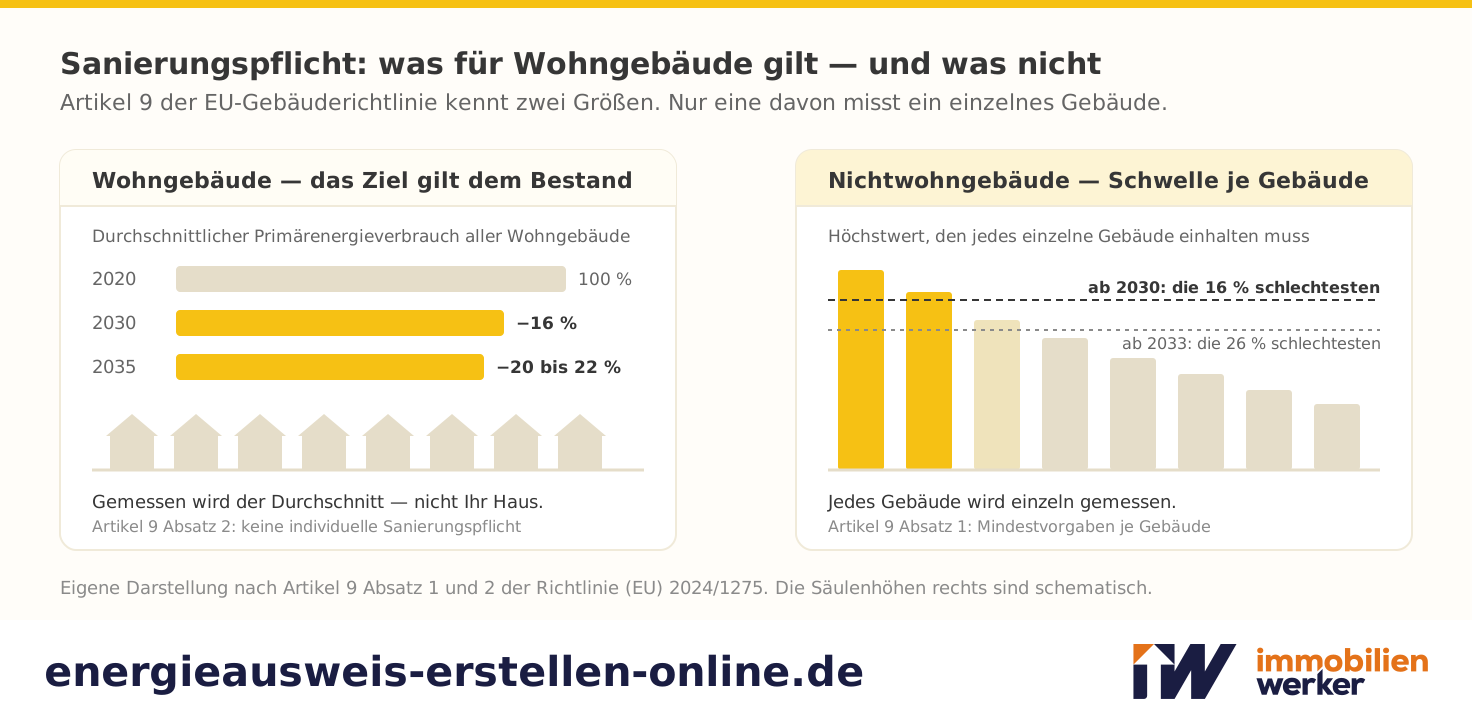
What applies instead is in Article 9 (2): the average primary energy use of the entire residential building stock must fall by at least 16 per cent compared with 2020 by 2030, and by 20 to 22 per cent by 2035.1 The federal information portal on building energy law draws the conclusion verbatim: “Thus no individual renovation duty is required for residential buildings.”2 How the federal government intends to reach this target for the stock is explained in the overview energy-efficient renovation and funding.
One qualification belongs here: the Directive does not prohibit minimum requirements for residential buildings; it names them as one possible measure. It simply does not prescribe them — and Germany has none.
| Topic | What is claimed | What actually applies |
|---|---|---|
| Reference quantity | the individual house | the average of the stock |
| Residential buildings 2030 | renovation to class E | minus 16 per cent across the stock |
| Non-residential buildings | same rule as for homes | threshold per building |
| Legal consequence for you | renovation order | none |
“Class F, G or H means forced renovation”
The energy efficiency class of a residential building is a conversion, not an order. Annex 10 of the Building Modernisation Act (Gebäudemodernisierungsgesetz, GModG) assigns the final energy value to one of the nine classes from A+ to H; the limits are 30, 50, 75, 100, 130, 160, 200 and 250 kilowatt-hours per square metre and year.9 Nothing more is written there, and no section attaches a renovation duty to any of these classes.
It has practical significance in the energy performance certificate (Energieausweis) and in the property advertisement. How it comes about is explained in the energy efficiency class in detail.
“My oil boiler that is over 30 years old has to go now”
It does not. The operating ban for old heating boilers — the section behind the thirty-year rule — has been abolished: since 29 July 2026 § 72 only carries the note “(repealed)”.8 The operating ban on fossil boilers planned for 2045 has disappeared with it. You may continue to operate a heating system that works and can be repaired; a buyer or heir does not have to replace it.
Also abolished is the duty to run a newly installed heating system on at least 65 per cent renewable energy.11 It is replaced by a rule that takes effect later and only concerns new installation: anyone who installs a gas, oil or liquefied petroleum gas heating system in an existing building after 29 July 2026 must use a rising share of climate-neutral fuels from 2029.6
Data as a table
| Label | Value in per cent |
|---|---|
| from 2029 | 10 |
| from 2030 | 15 |
| from 2035 | 30 |
| from 2040 | 60 |
None of this applies to systems already in the house: the duty is tied solely to installation.
“When buying a house I have to renovate within two years”
There is a kernel of truth here inside a false generalisation. After a change of ownership there is nothing to renovate; two individual building elements have to be retrofitted. First, the top floor ceiling if it does not meet the minimum thermal insulation: no more than 0.24 watts per square metre and kelvin, or alternatively the roof above it.4 Second, previously uninsulated, accessible heating and hot water pipes outside heated rooms.7
The deadline is misrepresented almost everywhere. It does not run from your purchase but “two years from the first transfer of ownership after 1 February 2002”.4 That date is the cut-off of a transitional rule for one- and two-family houses whose owners were living in them at the time. If the house has changed hands at least once since then, the deadline expired long ago — in that case both duties apply directly, including for the seller.
“The state doesn’t pay anything any more anyway”
Federal funding for efficient buildings (Bundesförderung für effiziente Gebäude) continues, in a new version since 21 July 2026. On the building envelope — insulation, windows, external doors — the basic funding rate is 15 per cent of the eligible expenditure; 5 per cent is added for an individual renovation roadmap, but only from 30,000 euros of eligible investment.12 KfW funds heating replacement with 30 per cent basic funding, capped at 70 per cent for owner-occupiers and at 80 per cent for those on a low income.13
The link is rarely mentioned: only what exceeds the legal requirements is funded. Anyone who merely fulfils their duty receives nothing — which is why it pays to combine the retrofit with a measure that goes beyond it. The sequence is set out in an individual renovation roadmap.
“Commercial property is subject to the same rules as my home”
Here the reverse is true: what does not apply to residential buildings very much applies to non-residential buildings. Article 9 (1) obliges the member states to set maximum values that every single non-residential building must meet — from 2030 the worst 16 per cent of the 2020 stock, from 2033 the worst 26 per cent.1 Checks are made building by building, expressly on the basis of the energy performance certificates.
Anyone who owns a practice, a shop unit or a hall should know the difference; details are set out under minimum standards for non-residential buildings. For the residential house next door this changes nothing.
What you actually have to do
Three duties remain, and all of them depend on a building element or an occasion — none on a calendar year.
The three duties that really exist
- Insulate the top floor ceiling if it does not meet the minimum thermal insulation: no more than 0.24 W/(m²·K) (§ 35 (1) GModG)
- Insulate accessible heating and hot water pipes where they are located outside heated rooms (§ 69 (2) GModG)
- Meet the building element requirements as soon as you renew anyway — de minimis threshold: 10 per cent per building element group (§ 36 GModG)
The third is the most important in everyday life because it is triggered without anyone noticing. Anyone who replaces three out of thirty windows stays below the de minimis threshold; anyone who insulates the façade or renews all the windows triggers the requirement of § 36 GModG.5 It becomes expensive not during the work but at the quotation stage: anyone who only learns about the requirement afterwards has signed the wrong contract.
Frequently asked questions about mandatory renovation
Why do I read something completely different elsewhere?
Because many overviews reflect the position before 29 July 2026 and cite §§ 47, 48, 71 and 72 of the Building Energy Act (Gebäudeenergiegesetz). These numbers no longer exist in that form: the retrofitting is now in § 35, the building element requirement in § 36, pipe insulation in § 69.
Does this also apply to a let owner-occupied flat?
The retrofitting duties fall on the owner of the building, not the tenant. The top floor ceiling and the basement pipes are common property — the owners’ association is responsible, not the individual flat.
What happens if I do not fulfil one of the three duties?
It is a regulatory offence, and the range goes up to 50,000 euros. The frequently mentioned 10,000 euros concern something else: breaches relating to the energy performance certificate.
Can this still change?
Yes. Parts of the EU Energy Performance of Buildings Directive only take effect in Germany on 1 January 2027, and an act on a green gas and green heating oil quota has also been announced. As things stand, both concern the building stock and fuels, not the individual residential building.
Is renovating still worthwhile, then?
That is an economic question, not a legal one. Only what goes beyond the legal requirement is funded. Anyone who is renewing a building element anyway decides on both at that moment: duty and grant.
Conclusion: no deadline, but three occasions
There is no deadline by which your residential building must have reached an efficiency class: the European requirement measures the average of the stock, and German law knows no class requirement. What does exist are three duties relating to building elements and a range of fines up to 50,000 euros. Since 29 July 2026 there have been fewer duties, not more. Anyone who wants to know where their building stands therefore starts not with the deadline but with the key figure.
Sources
- Directive (EU) 2024/1275 on the energy performance of buildings, Article 9 (version of 24 April 2024, retrieved 09/2026) eur-lex.europa.eu ↩1 ↩2 ↩3
- Federal GEG information portal (BBSR) — European Energy Performance of Buildings Directive (EPBD), retrieved 09/2026 gmodg.bund.de ↩1 ↩2
- European Commission, proposal for a recast of the Energy Performance of Buildings Directive, COM(2021) 802 final of 15 December 2021 eur-lex.europa.eu ↩
- Building Modernisation Act (GModG), § 35 — Retrofitting an existing building (version from 29.07.2026) gesetze-im-internet.de ↩1 ↩2 ↩3 ↩4
- Building Modernisation Act (GModG), § 36 — Requirements for an existing building when altered (version from 29.07.2026) gesetze-im-internet.de ↩
- Building Modernisation Act (GModG), § 43 — Installation of a heating system fired with gas, heating oil or liquefied petroleum gas (version from 29.07.2026) gesetze-im-internet.de ↩
- Building Modernisation Act (GModG), § 69 — Heat distribution and hot water pipes and fittings (version from 29.07.2026) gesetze-im-internet.de ↩
- Building Modernisation Act (GModG), § 72 — “(repealed)”, formerly the operating ban for heating boilers (version from 29.07.2026) gesetze-im-internet.de ↩
- Building Modernisation Act (GModG), Annex 10 (to § 86) — Energy efficiency classes of residential buildings (version from 29.07.2026) gesetze-im-internet.de ↩1 ↩2
- Building Modernisation Act (GModG), § 108 — Provisions on fines (version from 29.07.2026) gesetze-im-internet.de ↩
- Federal GEG information portal (BBSR) — New rules under the Building Modernisation Act, retrieved 09/2026 gmodg.bund.de ↩1 ↩2
- BAFA — Federal funding for efficient buildings, individual measures on the building envelope (information sheet July 2026, retrieved 09/2026) bafa.de ↩
- KfW — Heating subsidy for private individuals (458), version valid from 21 July 2026 (retrieved 09/2026) kfw.de ↩