MEPS from 2030: what applies to non-residential buildings — and not to homes

Christine Werker Energieberaterin (EEE) & Architektin
As of:
Anyone who owns or manages an office, retail or warehouse building has had a fixed figure in the Federal Law Gazette since 28 July 2026: from 1 January 2030, the annual primary energy demand of an existing non-residential building (Nichtwohngebäude) may be no more than 3.5 times that of a reference building, and from 2033 no more than 2.95 times.2 The provision is § 40 of the Building Modernisation Act (Gebäudemodernisierungsgesetz, GModG), in force from 1 January 2027.

It is the German version of what the market calls MEPS. This article explains which buildings it applies to, how to tell whether you are affected — and why no renovation duty follows for a home.
What are MEPS — and which buildings do they apply to?
MEPS stands for Minimum Energy Performance Standards.
- Minimum energy performance standards MEPS
-
Minimum energy performance standards (Mindestvorgaben für die Gesamtenergieeffizienz) are statutory upper limits on the energy demand of an existing building that must be met by a fixed deadline. Article 9 (1) of Directive (EU) 2024/1275 provides for them exclusively for non-residential buildings. They apply building by building: it is the individual building that is checked, not an average.
They are addressed to the owner, not the state: § 40 (1) sentence 1 obliges the owner to ensure compliance by suitable measures.2 Which measure that is, the Act expressly does not prescribe.3 The framework is set out in the overview of the Building Modernisation Act.
Which deadlines and thresholds apply?
The measurement is against a calculation model: the reference building has the same geometry and use, but technology specified in the Act. The comparison produces a factor — 2.0 means twice as much.
| Deadline | Maximum value | Lower limit of |
|---|---|---|
| 1 Jan 2030 | 3.5 times | class G |
| 1 Jan 2033 | 2.95 times | class F |
Source: Own illustration based on § 40 (2) GModG
Where do the figures come from? Each Member State sets a threshold “such that 16 % of its national non-residential building stock is above that threshold”, and a second one for 26 per cent, with the reference date 1 January 2020.1 It may correspond to an energy performance class — which is exactly what Germany did: in 2020, 294,000 buildings were above the threshold for 2030 — that is, in the worst sixth of the stock — and a further 185,000 above the one for 2033.3
How can I tell whether my building is affected?
From the energy performance certificate (Energieausweis). § 41 GModG names it as the means of proof: compliance must be “demonstrated at the request of the authority competent under state law … by means of an energy performance certificate or in another suitable manner”.2
A transitional rule applies to older documents: a demand certificate (Bedarfsausweis) issued before 1 January 2027 only serves as proof until the end of 2032 below 0.5 times the scale end value, and from 2033 below 0.4 times.2
Before that, the question is whether § 40 applies at all.
| Legal consequence | Cases |
|---|---|
| deemed met (§ 40 (3)) | built from 1996; level of the 1994 Thermal Insulation Ordinance; biomass; heat pump; district heating |
| not applicable (§ 40 (4)) | demolition, change of use, comprehensive renovation; listed building; industrial plant with low energy demand |
If anything remains, the duty lapses insofar as compliance is technically impossible or economically unreasonable.2 Anyone who ignores it commits an administrative offence: the breach becomes new no. 4 in § 108 and falls under “the other cases” — up to 5,000 euros, not the frequently quoted 50,000.6
How far has implementation progressed in Germany?
Late and in stages. The Directive had to be transposed by 29 May 2026;1 the German amending Act was only promulgated on 28 July 2026, and §§ 40 and 41 enter into force on 1 January 2027.28
Two things remain open: in the National Building Renovation Plan the thresholds “could not yet be specified”, and its final version is announced for the end of 2026; and so far they are not expressed in kilowatt-hours per square metre and year, as the European Commission’s guidance requires.5 The more recent Act is decisive; in the consolidated version online, both sections still appear as “(repealed)”.
What does this have to do with the new A to G scale?
Everything. From 1 January 2027, energy performance certificates for non-residential buildings carry a letter under Annex 10a, classified using the same ratio.2 The threshold for 2030 is the lower limit of class G, the one for 2033 that of class F — the letter is the yardstick, as the new A to G scale shows.
Does a renovation duty now apply to my home too?
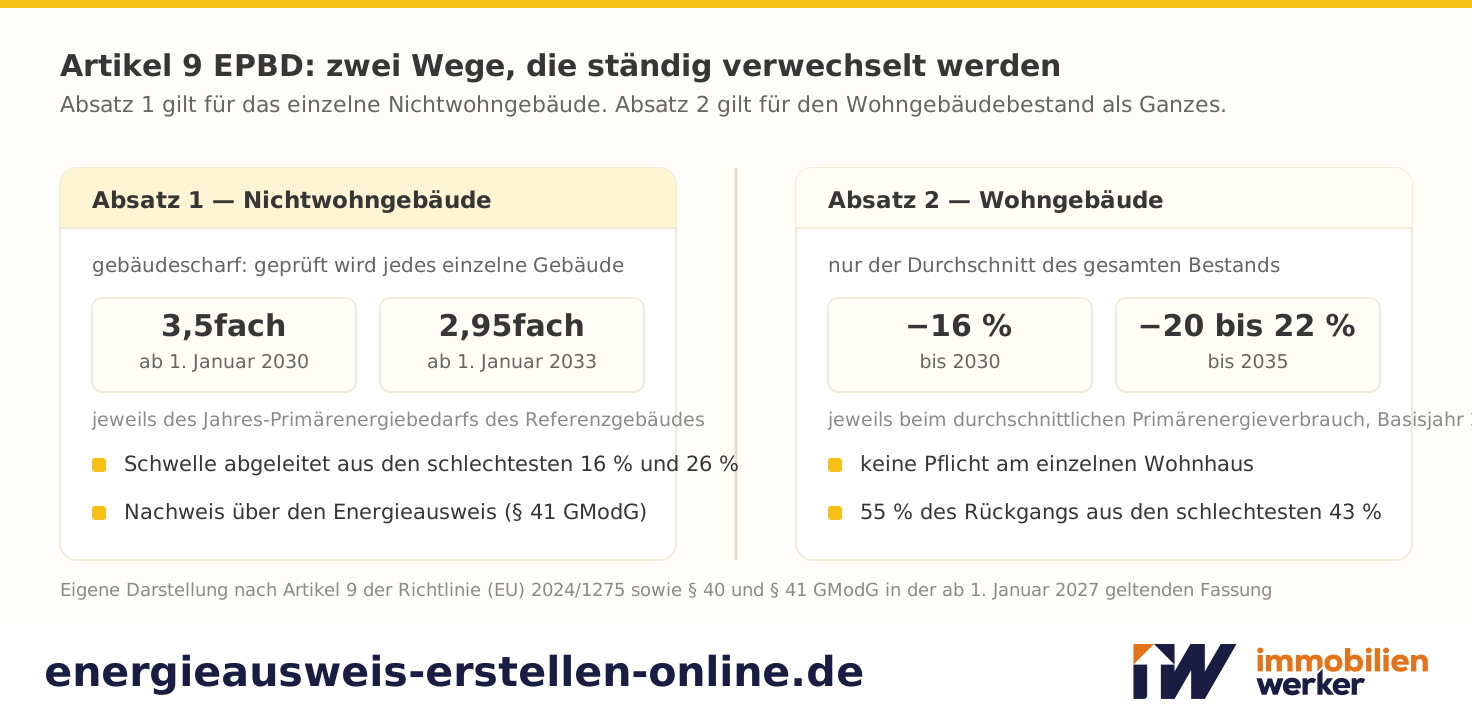
No. Article 9 contains two instruments, and only the first applies to the individual building. Paragraph 2 requires a national trajectory for residential buildings: the average primary energy consumption of the entire stock is to fall by at least 16 per cent by 2030 and by 20 to 22 per cent by 2035 compared with 2020.1 The obligation lies with the Member State, not the owner — in the words of the federal information portal: “Thus no individual renovation obligation is required for residential buildings.”4
| Feature | Non-residential buildings (paragraph 1) | Residential buildings (paragraph 2) |
|---|---|---|
| Effect | building by building | only the stock average |
| 2030 | at most 3.5 times | at least 16 % below 2020 |
| 2033 or 2035 | at most 2.95 times | 20 to 22 % below 2020 |
| Obligated party | the owner | the Member State |
| Sanction | administrative offence, § 108 GModG | none |
The confusion has a history: the Commission’s 2021 proposal still provided for class F by 2027 and class E by 2030.9 The adopted Directive does not say this — Renovation duty: myths and facts keeps the two apart.
What owners can sensibly do now
The first step costs nothing but a look: built from 1996, district heating, heat pump or biomass — then the requirement is met. Otherwise a calculated energy performance certificate for non-residential buildings is next; it is valid for ten years7 and serves as proof in every case from 2027. Finally, the sequence: the explanatory memorandum to the Act assumes 10 to 50 euros per square metre for low-investment measures and 50 to 300 euros for comprehensive ones3 — between the two, an individual renovation roadmap decides.
Frequently asked questions about MEPS
Three questions from practice
Do I have to renovate my office building by 2030?
Only if its annual primary energy demand is above 3.5 times that of the reference building. Construction from 1996, district heating, heat pumps and biomass count as compliance under § 40 (3) GModG.
Are 16 per cent of my properties affected?
No. The percentage describes the national stock as at 1 January 2020 and only determines the level of the threshold. It says nothing about an individual portfolio.
How do I prove that my building complies with the limit?
At the request of the competent state authority, by means of an energy performance certificate or in another suitable manner (§ 41 GModG). A demand certificate issued before 2027 is only sufficient below 0.5 times the scale end value.
Conclusion: building by building, but not for every building
MEPS are a duty of the owner and apply to the individual non-residential building: at most 3.5 times the reference building from 2030, 2.95 times from 2033. The percentages describe the national stock, not a portfolio; no renovation duty follows for residential buildings. The energy performance certificate stands in between.
Sources
- Directive (EU) 2024/1275 on the energy performance of buildings, Article 9 and Article 19 (Official Journal L of 8 May 2024) eur-lex.europa.eu ↩1 ↩2 ↩3 ↩4
- Act amending the Building Energy Act and further provisions in the heating sector, Federal Law Gazette 2026 I No. 226 of 28 July 2026 (§ 40 and § 41 pp. 23 f., § 108 pp. 32 f., Annex 10a p. 46, entry into force p. 59) recht.bund.de ↩1 ↩2 ↩3 ↩4 ↩5 ↩6 ↩7 ↩8
- Federal Government draft, Bundestag printed paper 21/6278 of 8 June 2026 — explanatory memorandum on § 40 and compliance costs (pp. 84 f., pp. 111 f.) dserver.bundestag.de ↩1 ↩2 ↩3
- Federal GEG information portal — European Energy Performance of Buildings Directive (EPBD), retrieved on 2 September 2026 gmodg.bund.de ↩
- Federal Ministry for Economic Affairs and Energy, draft National Building Renovation Plan (NBRP), as of 17 April 2026 bundeswirtschaftsministerium.de ↩
- Building Modernisation Act (GModG), § 108 — Provisions on fines (current version, as of 09/2026) gesetze-im-internet.de ↩1 ↩2
- Building Modernisation Act (GModG), § 79 — Principles of the energy performance certificate, ten-year validity (as of 09/2026) gesetze-im-internet.de ↩
- Federal GEG information portal — New rules of the Building Modernisation Act, retrieved on 2 September 2026 gmodg.bund.de ↩
- European Commission proposal for a recast of the Buildings Directive, COM(2021) 802 final of 15 December 2021 eur-lex.europa.eu ↩
This article reflects the position at the time of publication and does not replace legal or energy advice in an individual case. Binding are the Building Modernisation Act (Gebäudemodernisierungsgesetz, GModG) in its applicable version and the details in the issued energy performance certificate.