Consumption or demand certificate
Energy efficiency class of a house in Germany: what the letter means

Christine Werker Energieberaterin (EEE) & Architektin
As of:
On your energy performance certificate (Energieausweis) an arrow above the colour band points to a letter between A+ and H. This article is written for owners of a residential building who want to know where the letter comes from and what it says about their house. The short answer: it is not a professional judgement but the result of a division — with a reference area that many people confuse.

Six questions: what does the class measure, where do the nine boundaries lie, which class is typical in the existing stock, why is the neighbouring house rated differently, what changes in 2027 — and what does a better class bring?
What the efficiency class says — and how it is calculated
- Energy efficiency class
-
The energy efficiency class of a residential building is a rating from A+ to H that follows directly from the building’s final energy value — in kilowatt-hours per square metre of usable floor area and year. It describes the building, not the individual flat and not the habits of its occupants. Which letter comes out is decided solely by the table in Annex 10 to the Building Modernisation Act.
The law allows no discretion: the classes “follow directly from the final energy consumption or final energy demand”, says § 86 (2) of the Building Modernisation Act (Gebäudemodernisierungsgesetz, GModG).2 Two issuers with the same input data necessarily arrive at the same class. Where the letter sits in the overall picture is explained in the German overview of the energy performance certificate.
Its reach is just as clearly limited: certificates are meant “to enable a rough comparison of buildings” (§ 79 (1) GModG).5 The class is a comparative measure, not a forecast of your heating costs.
The most common mistake lies in the reference area. Annex 10 literally heads its numeric column “final energy [kilowatt-hours per square metre of usable floor area and year]”.1 That is not the living space but as a rule larger: if it is unknown, § 82 (2) sentence 4 GModG allows it to be taken as 1.35 times the living space — for buildings with up to two flats and a heated basement, otherwise 1.2 times.3
Why the rough estimate with the living space comes out too low
A detached house with a heated basement uses on average 21,000 kilowatt-hours a year over the last three years; the living space is 150 square metres.
Living space: 21,000 ÷ 150 = 140 kWh/(m²·a)
Usable floor area: 150 × 1.35 = 202.5 m², so 21,000 ÷ 202.5 = about 104 kWh/(m²·a)
Example values; on the certificate, weather adjustment and the hot-water allowance are added.
Result 140 instead of 104 kWh/(m²·a) — class E instead of D
Which classes exist and where the boundaries lie
Nine steps, eight upper limits, one open class at the end:
Energy efficiency classes of residential buildings under Annex 10 to the GModG
- A+ up to 30 kWh/(m²·a)
- A up to 50 kWh/(m²·a)
- B up to 75 kWh/(m²·a)
- C up to 100 kWh/(m²·a)
- D up to 130 kWh/(m²·a)
- E up to 160 kWh/(m²·a)
- F up to 200 kWh/(m²·a)
- G up to 250 kWh/(m²·a)
- H over 250 kWh/(m²·a)
The boundaries are stated in the Act as “less than or equal to”.1 Exactly 100 kilowatt-hours is therefore still class C; only a value above it makes it D.
| Class | Final energy in kWh/(m²·a) | With 150 m² of usable floor area |
|---|---|---|
| A+ | up to 30 | up to 4,500 kWh |
| A | over 30 to 50 | 4,500–7,500 kWh |
| B | over 50 to 75 | 7,500–11,250 kWh |
| C | over 75 to 100 | 11,250–15,000 kWh |
| D | over 100 to 130 | 15,000–19,500 kWh |
| E | over 130 to 160 | 19,500–24,000 kWh |
| F | over 160 to 200 | 24,000–30,000 kWh |
| G | over 200 to 250 | 30,000–37,500 kWh |
| H | over 250 | over 37,500 kWh |
Which class a typical German house has
There is no reliable answer to that — and that is the finding. An expert report by the Institute for Ecological Economy Research sets five data sources side by side: the share of buildings in classes G and H ranges in them from 5 per cent to almost 40 per cent.9 The data situation is inadequate, the authors note.
They name three reasons: demand or consumption, counted by buildings or by floor area, and the fact that certificates only arise on specific occasions — so rather for the better buildings.
What is reliable is the look at the age of the stock: 60 per cent of all residential buildings date from construction periods up to 1979.10 Anyone who owns an unrenovated house from that time had better reckon with the rear part of the scale.
Why the neighbour with the same house has a different class
Because the same letter can come from two procedures. The demand certificate calculates from building components and technical systems under standard conditions (§ 81 GModG),4 the consumption certificate evaluates real bills (§ 82 GModG).3 Which type is permitted is explained in the comparison consumption or demand certificate.
Four adjusting screws shift the result without anything about the building changing:
What drives two certificates for the same house apart
- Occupant behaviour: a frugally heated house comes out better on the consumption certificate than it was built — the demand certificate does not know this effect.
- Period: the basis is at least 36 consecutive billing months; a different three-year period gives a different value.
- Vacancy: longer vacancies must be taken into account in the calculation; otherwise a half-empty house would look efficient.
- Hot water: if the consumption for decentralised hot water is unknown, a flat 20 kilowatt-hours per square metre and year are added on top.
The weather, by contrast, drops out: heating consumption is weather-adjusted (§ 82 (3) GModG), and the climate factors of the German Meteorological Service are binding per postcode.11 A cold winter therefore does not push you into a worse class.
Does the scale change to A to G in 2027?
Not for your home.
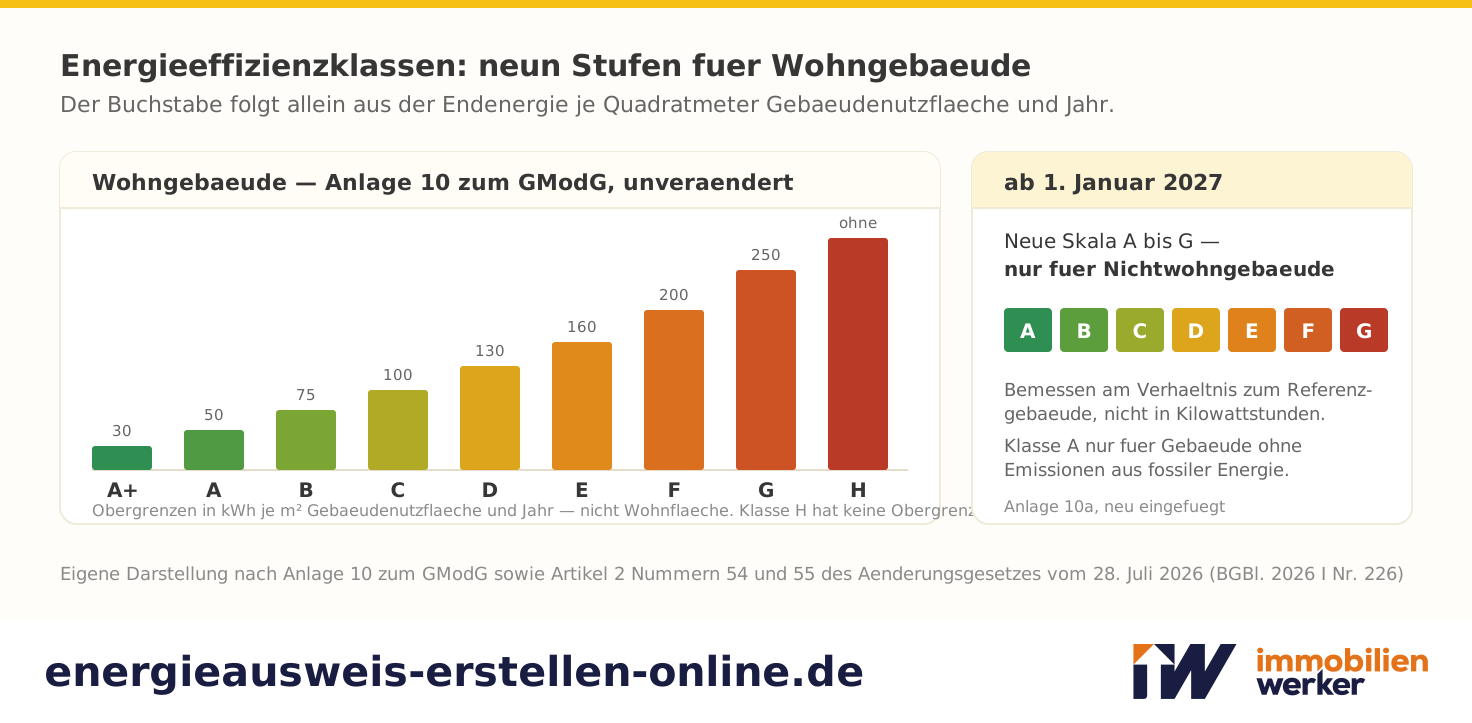
The origin of the confusion lies in Brussels: Article 19 (2) of the EU Energy Performance of Buildings Directive requires a closed scale “using exclusively the letters A to G”, with A corresponding to zero-emission buildings and G to the worst buildings of the national stock.8 The same paragraph allows a deferral until the end of 2029 for member states that rescaled their classes between 2019 and May 2024. For German residential buildings no rescaling has been decided so far. What the amendment means for commercial property is explained in the German article on the new A to G scale from 2027.
What a better class brings — and how to get there
First, visibility: as soon as a certificate exists, the efficiency class of a residential building belongs in every property advertisement in commercial media (§ 87 (1) no. 5 GModG).6 It is in the listing before anyone has set foot in the house.
What it moves in the price cannot be quantified seriously. The Federal Institute for Research on Building, Urban Affairs and Spatial Development calls the effect of a building’s energy quality on rent and purchase price “not yet clearly established”.12 The percentages in circulation come from listing analyses by comparison portals.
The physical part is certain: one class better means less final energy per square metre. The way there is shown by the certificate itself, because the modernisation recommendations are a mandatory component. Which measure pays off is covered in the German article on energy-efficient renovation and funding; where the class sits on the form is shown by the sample certificate.
Frequently asked questions about the efficiency class
Which efficiency class is good?
Class C and better means at most 100 kilowatt-hours per square metre and year and usually stands for a new building or a comprehensive modernisation.
Can I calculate my efficiency class myself?
Roughly, yes: annual consumption divided by the usable floor area, then look up the result in the table above. It is not binding — on the certificate, weather adjustment, vacancy correction and, where applicable, the hot-water allowance are added.
How much heating cost does my efficiency class mean?
The class states kilowatt-hours, not euros. Multiply the figure by your usable floor area and your unit price — the table above shows the first step. The certificate is expressly not a cost forecast (§ 79 (1) GModG).
Do I have to renovate my house because of a bad class?
For residential buildings in Germany there is no minimum class and no renovation duty tied to the class. Which duties really exist is sorted out in the German article renovation duty: claims and facts.
Does my flat have its own class?
No. An energy performance certificate is issued for a building (§ 79 (2) GModG); the class belongs to the whole house.
Conclusion: one division, two procedures, one scale that stays
The efficiency class of your house is the final energy value per square metre of usable floor area, placed into nine fixed steps — there is no more to it. Looking at the reference area is therefore worth more than debating the letter. And for residential buildings the scale remains: A+ to H.
Sources
- Building Modernisation Act (GModG), Annex 10 (to § 86) — Energy efficiency classes of residential buildings (consolidated version, as of 09/2026) gesetze-im-internet.de ↩1 ↩2 ↩3
- Building Modernisation Act (GModG), § 86 — Energy efficiency class of a residential building (as of 09/2026) gesetze-im-internet.de ↩
- Building Modernisation Act (GModG), § 82 — Energy consumption certificate (as of 09/2026) gesetze-im-internet.de ↩1 ↩2 ↩3 ↩4
- Building Modernisation Act (GModG), § 81 — Energy demand certificate (as of 09/2026) gesetze-im-internet.de ↩
- Building Modernisation Act (GModG), § 79 — Principles of the energy performance certificate (as of 09/2026) gesetze-im-internet.de ↩
- Building Modernisation Act (GModG), § 87 — Mandatory details in a property advertisement (as of 09/2026) gesetze-im-internet.de ↩
- Act amending the Building Energy Act and further provisions in the heating sector, Federal Law Gazette 2026 I No. 226 of 28 July 2026 (Article 2 nos. 54 and 55, Article 9 (2)) recht.bund.de ↩
- Directive (EU) 2024/1275 on the energy performance of buildings, Article 19 (2) (EUR-Lex, version of 8 May 2024) eur-lex.europa.eu ↩
- Institute for Ecological Economy Research (IÖW) for the Academies' Project Energy Systems of the Future, Socio-technical analysis of the worst performing buildings in Germany, Figure 3.5 (as of 12 January 2024) ioew.de ↩
- German Energy Agency (dena), dena Building Report 2026, Figure 03 — residential building stock by construction period in 2024 (as of January 2026) dena.de ↩1 ↩2
- Federal GModG information portal, climate factors for energy consumption certificates (retrieved 2 September 2026) gmodg.bund.de ↩
- Federal Institute for Research on Building, Urban Affairs and Spatial Development (BBSR), Residential and commercial property in Germany 2025, page 27 (expert panel property market 2024, n = 533 in the residential segment) bbsr.bund.de ↩
This article reflects the position at the time of publication and does not replace legal or energy advice in an individual case. Binding are the Building Modernisation Act (Gebäudemodernisierungsgesetz, GModG) in its applicable version and the details in the issued energy performance certificate.