iSFP: what the individual renovation roadmap delivers and what the bonus pays

Christine Werker Energieberaterin (EEE) & Architektin
As of:
Anyone who wants to renovate their house for energy efficiency comes across four letters: iSFP. This article is aimed at owners of a residential building who are facing larger measures and want to know whether the detour via energy advice is worthwhile. The short answer: the individual renovation roadmap is not an energy performance certificate and does not replace one — it is a subsidised plan, and its monetary value shifted on 21 July 2026.

Five questions in turn: what it contains, what it costs, what the bonus delivers today, how the procedure works — and when you also need an energy performance certificate.
What is an individual renovation roadmap — and what does it contain?
An individual renovation roadmap (individueller Sanierungsfahrplan, iSFP) is a subsidised energy advice report for a specific residential building: an energy efficiency expert surveys the house on site and sets out which renovation steps make sense in which order, what they cost and what they save. That is how the funding guideline for federal funding for efficient buildings (Bundesförderung für effiziente Gebäude) defines it.1 It is the individual case within the overview of renovation and funding.
What you hold in your hands after the advice
“My renovation roadmap” (Mein Sanierungsfahrplan)
The summary — current condition, packages of measures, sequence, costs and savings.
“Implementation guide for my measures” (Umsetzungshilfe für meine Maßnahmen)
The detailed part on each measure — the booklet for talking to tradespeople.
Two routes in the same report
Step-by-step renovation and complete renovation in one go are presented side by side.7
A roadmap may contain two to five packages of measures that build on one another, each with up to five components.6 The condition is not expressed in letters but in seven colour classes based on the specific primary energy demand.
Data as a table
| Label | Value in kWh/(m²·a) |
|---|---|
| Dark green | 30 |
| Green | 60 |
| Light green | 90 |
| Yellow | 130 |
| Orange | 180 |
| Red | 230 |
Green means: at the level of today’s requirements for new buildings. Unlike with the consumption certificate (Verbrauchsausweis), the occupants’ behaviour does not count — the calculation is made under standard conditions.8
What does an iSFP cost, and what does the state contribute?
The federal government covers 50 per cent of the eligible advisory fee — up to 650 euros for a one- or two-family house and up to 850 euros from three residential units.2 If the expert explains the result at a meeting of the owners’ association, a one-off amount of up to 250 euros per association is added. What remains depends on the fee: the consumer advice centre (Verbraucherzentrale) puts the owner’s share at 700 to 1,500 euros (as of 10/2025).11 There are no official fee statistics — obtain two quotes.
What does the iSFP bonus deliver — and does it cover the cost of the advice?
This is the economic core, and this is where most of the outdated information on the web is found. Since 21 July 2026 the rule is: if a measure from a subsidised roadmap is implemented within 15 years of its preparation and with an eligible minimum investment volume of 30,000 euros gross, the funding rate rises by five percentage points — but only for expenditure above the ceiling that applies without a roadmap.1 For a detached house this means: the first 30,000 euros at 15 per cent, the amount above that up to 60,000 euros at 20 per cent.
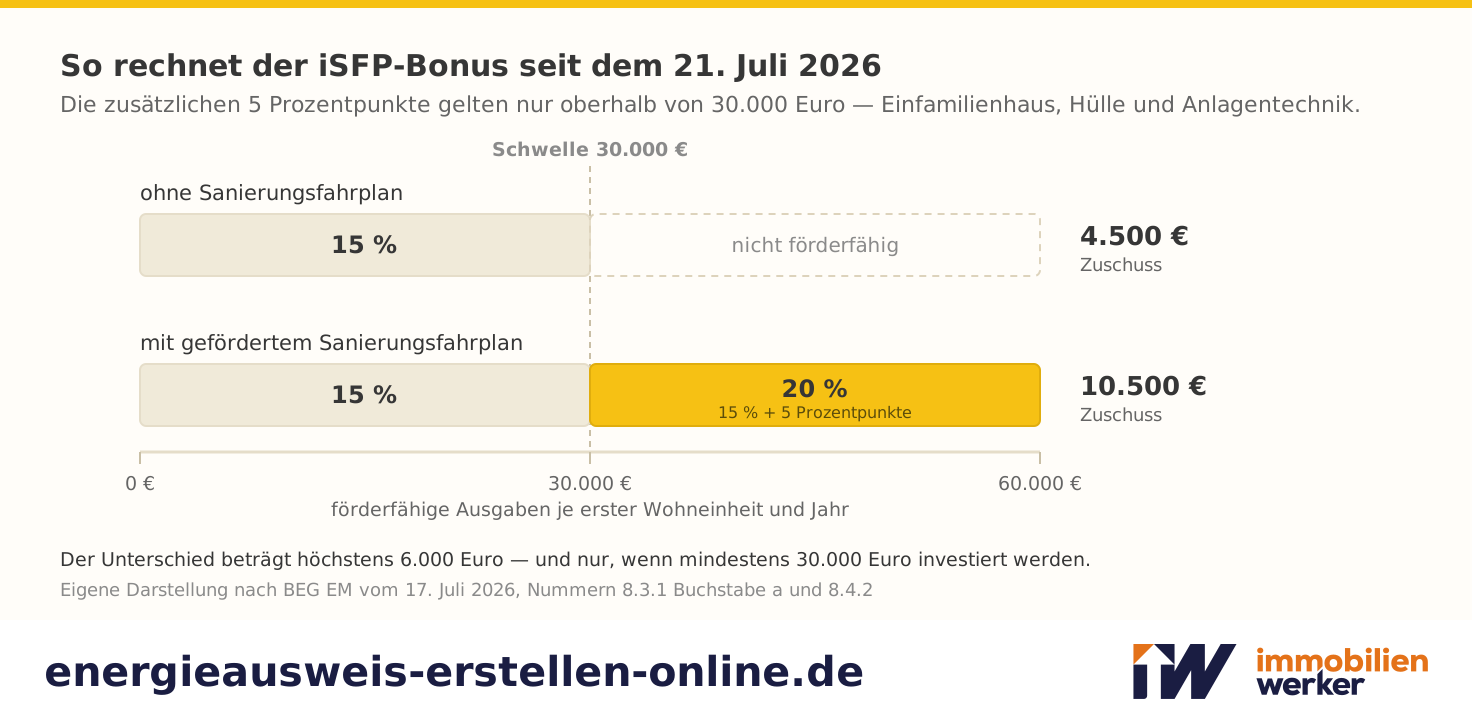
Insulation and windows for 55,000 euros, detached house
Without a renovation roadmap the assessment basis ends at 30,000 euros:
30,000 € × 15 % = 4,500 €
With a subsidised roadmap the minimum investment volume is met, the ceiling rises to 60,000 euros, and the expenditure counts in full:
30,000 € × 15 % = 4,500 € 25,000 € × 20 % = 5,000 € Total: 9,500 €
A roadmap cannot bring more than 6,000 euros per first residential unit and year: 4,500 euros from the higher assessment basis, 1,500 euros from the five percentage points.
Result 9,500 euros instead of 4,500 euros — a difference of 5,000 euros
Three restrictions go with this. First, the new heating system is excluded: heat generation systems are expressly not covered by the bonus.1 Second, the roadmap must already exist when the application is made — it cannot be submitted later. Third, the sequence is more flexible than many assume: exceeding requirements and changes in timing do no harm; only a substantial shortfall costs the measure its status.1
Who prepares the roadmap, how does it work and how long does it take?
Only someone listed in the energy efficiency expert list for federal funding programmes (Energieeffizienz-Expertenliste) in the category “Energy advice for residential buildings” may prepare it.3 The list is a joint institution of BMWE, BMWSB, BAFA, KfW and dena and can be searched publicly.10 For the energy performance certificate the same system applies in a different category — who is allowed to issue an energy performance certificate.
The approved advice must be completed within nine months of the grant notice, and the proof of use follows within six months.3 Print application 2.6 takes up requirements of the EU Energy Performance of Buildings Directive and also shows the efficiency class of the energy performance certificate.9
Do I need a renovation roadmap or an energy performance certificate?
Both describe the same building and answer different questions. The energy performance certificate (Energieausweis) “serves exclusively to provide information on the energy characteristics of a building” and is intended “to enable a rough comparison of buildings” — so says § 79 (1) of the Building Modernisation Act (Gebäudemodernisierungsgesetz, GModG) verbatim.4 It does contain modernisation recommendations, but expressly only “in the form of brief technical pointers” (§ 84 (1) GModG).5 That is exactly where the certificate stops and the roadmap begins.
| Criterion | Energy performance certificate | Renovation roadmap |
|---|---|---|
| Purpose | comparing buildings | planning your own renovation |
| Legal status | mandatory on sale and new letting | voluntary |
| Recommendations | brief pointers | packages with costs and sequence |
| Rating scale | classes A+ to H | seven colour classes |
| Validity | 10 years | 15 years for the bonus |
| Funding for the document | none | 50 %, max. 650 € or 850 € |
The period of validity of the certificate is set out in § 79 (3) GModG.4 In practice this means: on sale or new letting you need the certificate, when renovating the roadmap. Anyone planning both should first have the demand certificate (Bedarfsausweis) issued — it calculates with the same building element data that the advice records anyway. Which certificate type is permitted is clarified in the comparison consumption or demand certificate.
Frequently asked questions about the individual renovation roadmap
Do I have to implement the measures from the roadmap?
No. The renovation roadmap obliges you to nothing; it shows which steps would make sense in which order. Anyone who implements nothing merely loses the entitlement to the bonus.
How long is an iSFP valid?
Fifteen years from the day it was prepared. For that long a measure from it can trigger the bonus (BEG EM number 8.4.2).
Does the roadmap always bring five per cent more funding?
No, and that is the most common misconception. Since 21 July 2026 the bonus only applies from 30,000 euros of eligible expenditure, and the five percentage points apply only above this threshold.
Does the bonus also apply to a new heating system?
No. Heat generation systems are expressly excluded. For them there is the basic funding and the separate heating bonuses, but no supplement for the roadmap.
Does the renovation roadmap replace the energy performance certificate?
No. The certificate is mandatory on sale and new letting and is valid for ten years; the roadmap is voluntary and serves planning. If in doubt, you need both.
Conclusion: a plan with a price tag, not a substitute for the certificate
After deducting the funding, the individual renovation roadmap usually costs a mid three-figure sum and in return provides a reliable sequence including costs and savings. In arithmetic terms it pays for itself as soon as you invest more than 30,000 euros in the building envelope and building services in one year — below that, since July 2026, it no longer brings a bonus. It does not help with selling or letting: for that you need the energy performance certificate, whether you ever renovate or not.
Sources
- BMWE — Funding guideline for federal funding for efficient buildings, individual measures (BEG EM) of 17 July 2026, in force since 21 July 2026 energiewechsel.de ↩1 ↩2 ↩3 ↩4 ↩5 ↩6 ↩7
- BAFA — Federal funding for energy advice for residential buildings (page as of 30.04.2026) bafa.de ↩1 ↩2
- BMWE funding database — Energy advice for residential buildings, conditions and application procedure (retrieved 09/2026) foerderdatenbank.de ↩1 ↩2 ↩3
- Building Modernisation Act (GModG), § 79 — Principles of the energy performance certificate (as of 09/2026) gesetze-im-internet.de ↩1 ↩2
- Building Modernisation Act (GModG), § 84 — Recommendations for improving energy efficiency (as of 09/2026) gesetze-im-internet.de ↩
- KfW — The individual renovation roadmap (iSFP) (page as of 2026) kfw.de ↩
- dena, Gebäudeforum klimaneutral — The individual renovation roadmap (iSFP) (as of 08/2026) gebaeudeforum.de ↩
- dena — Guide to preparing the individual renovation roadmap, handbook for energy consultants, Table 2 class limits for primary energy demand (12/2021) gebaeudeforum.de ↩
- Federal Office for Energy Efficiency (BfEE) — New version 2.6 of the iSFP print application, announcement of 30.06.2026 bfee-online.de ↩
- Energy efficiency expert list for federal funding programmes (retrieved 09/2026) energie-effizienz-experten.de ↩
- Verbraucherzentrale — “Individueller Sanierungsfahrplan (iSFP): Modernisieren mit Köpfchen” (as of 28.10.2025) verbraucherzentrale.de ↩