Energy performance certificate: who pays — landlord or tenant?

Christoph Werker Energieberater & Geschäftsführer
As of:
You are letting to a new tenant and wonder whether the energy performance certificate will stay on your bill — or you are a tenant and have found the item in your service charge statement. This article is written for both sides of a residential tenancy; the answer is the same.

First, whom the costs fall on in which situation. Then the contentious question: why passing the cost on is ruled out — and why the usual reasoning for this is the wrong one. Finally, what a tenant can do if the certificate does appear in the statement.
Who pays for the energy performance certificate — and why is it not stated anywhere in the Act?
The energy performance certificate (Energieausweis) is paid for by whoever has the duty to have it issued: the owner for a new building, the seller on a sale, the landlord on a letting. The Building Modernisation Act (Gebäudemodernisierungsgesetz, GModG) contains no separate cost rule — it allocates duties, and the bill follows them.
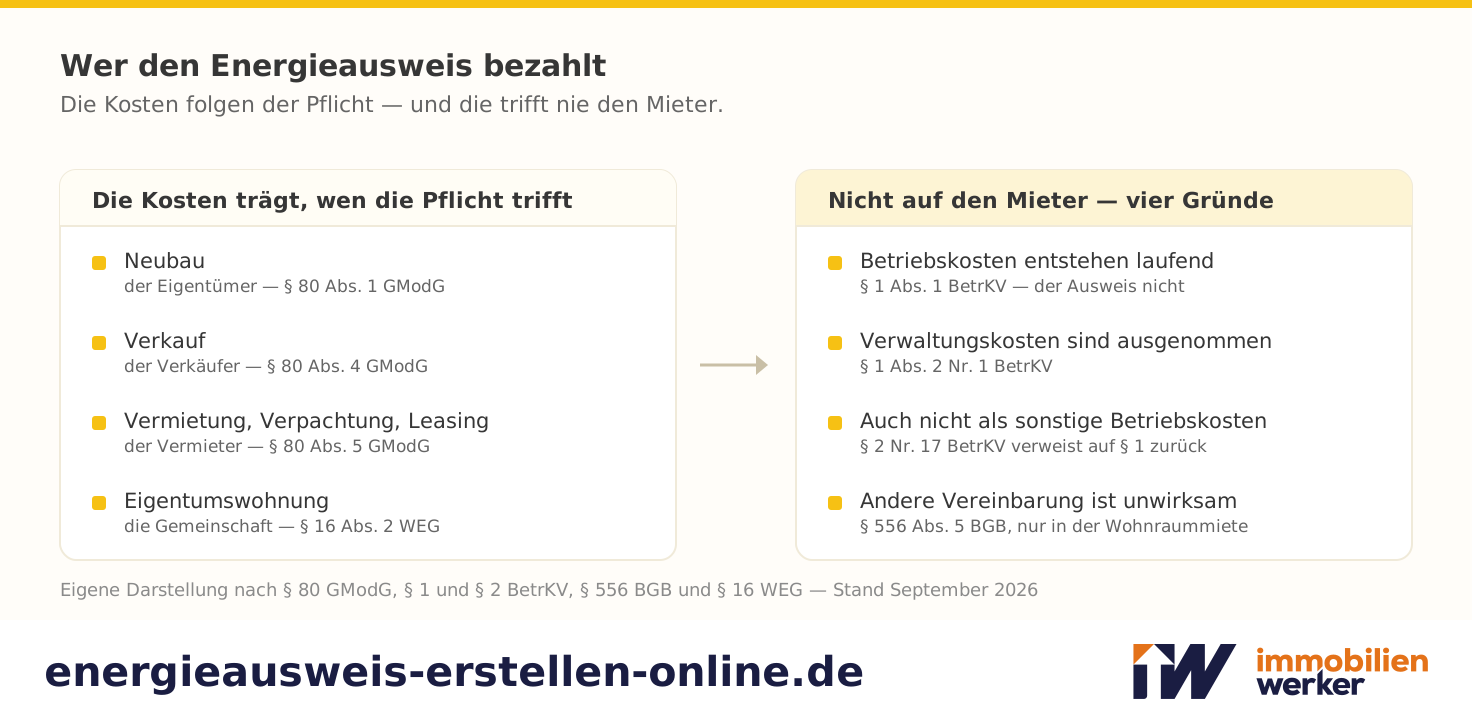
This can be read in § 80 GModG.1 Subsection 1 sentence 2 names the owner for a new building; subsection 3 is worded impersonally — “an energy performance certificate is to be issued” — and only subsections 4 and 5 name those who act: seller, landlord, lessor, leasing provider and, on an equal footing, the estate agent. Anyone who has to present and hand over the certificate must have it beforehand. That answers the cost question without any section using the word “costs”.
The rest of the chain of duties is set out in energy performance certificate on sale and letting; here it is only about the bill.
| Situation | Who pays | Legal basis |
|---|---|---|
| Sale | the seller, see house sale | § 80 (4) GModG |
| New letting, leasing, leasing arrangements | landlord, lessor, leasing provider | § 80 (5) GModG |
| New building | the owner, alternatively the developer | § 80 (1) GModG |
| Owner-occupied flat | the association of flat owners | § 79 (2) GModG, § 16 (2) WEG |
| Inheritance and gift | nobody — no occasion | § 80 (3) GModG mentions neither |
| Compulsory auction | nobody — not a sale | official federal interpretation |
| Commercial letting | the landlord, but passing it on can be agreed | § 578 (2) BGB |
Two rows in detail. For an owner-occupied flat the certificate covers the building, never the individual flat (§ 79 (2) GModG);2 if the association obtains it, each owner bears the costs according to their share (§ 16 (2) of the Condominium Act, WEG).8 With inheritance, gift and compulsory auction no duty arises at all11 — acquiring ownership by sovereign act is not a sale.9
May the landlord pass the costs on through the service charges?
No. The reasoning is more interesting, because the familiar one is wrong. “The energy performance certificate is not in the catalogue of the Operating Costs Ordinance” — this sentence appears on almost every page on the subject and does not hold. § 2 of the Operating Costs Ordinance (Betriebskostenverordnung, BetrKV) nowhere describes itself as exhaustive, and number 17 is a catch-all provision: “other operating costs; these include operating costs within the meaning of § 1 that are not covered by numbers 1 to 16.”4 A catalogue with an open last line excludes nothing.
The answer lies one step earlier, in the definition itself.
- Operating costs (Betriebskosten)
-
Under § 1 (1) of the Operating Costs Ordinance, operating costs are the costs that arise on an ongoing basis for the owner through ownership of the property or through the intended use of the building. Subsection 2 expressly excludes two groups: administration costs and maintenance costs. These criteria decide — not the catalogue, which merely spells them out.
So there are three conditions, and all must be met. The energy performance certificate already fails the first: it arises from a one-off occasion and recurs after ten years at the earliest (§ 79 (3) GModG). It also fails the second, because obtaining it is administration. Whether it would fit into number 17 no longer even comes up.
| Condition | Provision | Energy performance certificate |
|---|---|---|
| arising on an ongoing basis | § 1 (1) BetrKV | no |
| not administration costs | § 1 (2) no. 1 BetrKV | no |
| named in the catalogue | § 2 BetrKV | not applicable |
Source: Own illustration based on § 1 and § 2 BetrKV, as of 09/2026
That is how the associations reason. The Berliner Mieterverein (Berlin tenants’ association) writes that the costs are “not to be passed on to the rent, not even as other operating costs, because the feature of arising on an ongoing basis, which is necessary for passing on operating costs, is already lacking”.11 The consumer advice centre (Verbraucherzentrale) says the same more briefly.10 What is notable is who does not contradict this: not even Haus & Grund, the homeowners’ association.
What to do if the energy performance certificate appears in your service charge statement?
It rarely appears under its own name. More common are collective items such as “energy consultancy”, “expert fees” or “other operating costs” — in a statement with two dozen lines this does not stand out. Taking action against it is simple but subject to a deadline.
Four steps for tenants
-
Note the date of receipt
From receipt of the statement, twelve months run for your objections (§ 556 (3) sentence 5 of the German Civil Code, BGB). After that they are excluded.
-
Demand to inspect the receipts
On request the landlord must grant access to the receipts, electronically as well (§ 556 (4) BGB). Only the invoice shows what is contained in a collective item.
-
Object in writing
One sentence is enough if it names the provision — not arising on an ongoing basis (§ 1 (1) BetrKV), administration costs (subsection 2 no. 1). Pay the rest so that you do not fall into arrears.
-
Demand a corrected statement
If the landlord insists, the local tenants’ association can help. The burden of proof that the costs can be passed on lies with the landlord, not with you.
Can something else be agreed — in the tenancy agreement or with the estate agent?
Not in a residential tenancy agreement: § 556 (5) BGB declares any agreement invalid that deviates from the operating cost rules to the tenant’s detriment.5 How strict this restriction is, the Federal Court of Justice (Bundesgerichtshof) shows in a related case — a separately stated flat-rate administration charge in a standard-form tenancy agreement is invalid (judgment of 19 December 2018, VIII ZR 254/17).13 The judgment still cites subsection 4; the provision has since moved on by one number.
In a commercial tenancy it is different: § 578 (2) BGB lists which residential provisions apply to premises that are not residential — § 556 BGB is not among them.6 There, freedom of contract prevails, and passing the cost on can be agreed if it is described with sufficient precision.
And the estate agent? Under § 80 GModG they are themselves obliged to present the certificate, not merely your messenger.1 They are only entitled to reimbursement of expenses if this has been agreed — so says § 652 (2) BGB, even if no contract comes about.7 Without such an agreement, obtaining the certificate is deemed to be covered by the commission.
As a landlord you can in principle deduct the expense for tax purposes — details in Is the energy performance certificate tax-deductible?. What it costs depends on the certificate type; online from 69.90 €, the breakdown in what an energy performance certificate costs.
Frequently asked questions on the cost question
What landlords and tenants most often ask about the costs
Can the energy performance certificate be passed on to tenants?
No. The feature of costs arising on an ongoing basis is already missing (§ 1 (1) BetrKV), and obtaining the certificate is an administration cost, which § 1 (2) no. 1 BetrKV excludes. “Other operating costs” does not help either — the item only covers costs that meet the same definition.
Who bears the costs of the energy performance certificate?
Whoever bears the duty: the owner for a new building, the seller on a sale, the landlord on a letting, the association for an owner-occupied flat. The Act governs duties, not costs — the bill follows them.
Is a tenant entitled to the energy performance certificate?
As a prospective tenant yes — at the latest at the viewing. As an existing tenant no: the certificate is meant to support the decision before the contract is concluded, and that decision is made with the signature.
Does anything change on the cost question on 1 January 2027?
Not as things stand. The amendment rewords occasions and mandatory details; it does not touch the Operating Costs Ordinance.
Conclusion: the bill follows the duty
Whoever has to present the energy performance certificate pays for it — owner, seller, landlord, and for an owner-occupied flat the association. Passing it on does not fail because the certificate is missing from a list, but because of the definition of operating costs: it does not arise on an ongoing basis, and it is administration. Anyone who still finds it in a statement has twelve months from receipt to object in writing.
Sources
- Building Modernisation Act (GModG), § 80 — Issuing and use of energy performance certificates (version 09/2026) gesetze-im-internet.de ↩1 ↩2
- Building Modernisation Act (GModG), § 79 — Principles of the energy performance certificate (version 09/2026) gesetze-im-internet.de ↩
- Operating Costs Ordinance (Betriebskostenverordnung, BetrKV), § 1 — Operating costs (version 09/2026) gesetze-im-internet.de ↩1 ↩2
- Operating Costs Ordinance (Betriebskostenverordnung, BetrKV), § 2 — List of operating costs (version 09/2026) gesetze-im-internet.de ↩1 ↩2
- German Civil Code (BGB), § 556 — Agreements on operating costs (version 09/2026) gesetze-im-internet.de ↩1 ↩2
- German Civil Code (BGB), § 578 — Tenancies of land and premises (version 09/2026) gesetze-im-internet.de ↩
- German Civil Code (BGB), § 652 — Accrual of the claim to remuneration (version 09/2026) gesetze-im-internet.de ↩
- Condominium Act (Wohnungseigentumsgesetz, WEG), § 16 — Benefits and costs (version 09/2026) gesetze-im-internet.de ↩
- Federal GEG information portal, Questions and answers on energy performance certificates (retrieved 2 September 2026) gmodg.bund.de ↩
- Verbraucherzentrale, “Für wen ein Energieausweis zur Immobilie Pflicht ist” (for whom an energy performance certificate is mandatory; as of 31 August 2026) verbraucherzentrale.de ↩
- Berliner Mieterverein (Berlin tenants' association), Info 156: The energy performance certificate (as of 6/21, retrieved 2 September 2026) berliner-mieterverein.de ↩1 ↩2
- Deutscher Mieterbund (German Tenants' Association), “Alle Betriebskostenarten im Überblick” (all types of operating costs at a glance; 18 December 2025) mieterbund.de ↩
- Haufe, “BGH: Verwaltungskosten nicht auf Wohnungsmieter umlegbar” (Federal Court of Justice: administration costs cannot be passed on to residential tenants) on BGH, judgment of 19 December 2018 – VIII ZR 254/17 (retrieved 2 September 2026) haufe.de ↩
This article reflects the position at the time of publication and does not replace legal or energy advice in an individual case. Binding are the Building Modernisation Act (Gebäudemodernisierungsgesetz, GModG) in its applicable version and the details in the issued energy performance certificate.