Energy performance certificate when selling a house in Germany: when to show it, when to hand it over

Christoph Werker Energieberater & Geschäftsführer
As of:
You want to sell your house and are wondering when the energy performance certificate (Energieausweis) is actually due. The widespread answer “by the notary appointment” is wrong: the notary appointment does not appear in the law at all, and of the two real deadlines one lies before it and the other after. This article is written for owners of a residential building who sell themselves or instruct an estate agent — not for landlords and not for buyers.

It runs along the timeline of a sale: decision to sell, listing, viewing, purchase contract, handover. At each station it states what the Building Modernisation Act (Gebäudemodernisierungsgesetz, GModG) requires, what an omission costs and which certificate type you may choose. Finally, the question that moves the most money in a sale: what the efficiency class does to the price.
From when do you need the certificate — when you first think of selling, or only with the agent?
The duty hangs not on a date but on an intention. § 80 (3) sentence 1 GModG phrases it prospectively: “If a plot developed with a building […] is to be sold […], an energy performance certificate is to be issued unless a valid certificate for the building already exists.”2 From the moment the sale is decided, you owe the certificate — not from the moment someone wants to see it.
The certificate therefore belongs at the start of marketing. It is valid for ten years,1 so there is no “too early” — only a “too late”, and that begins with the first viewing appointment. How selling and letting differ is set out in the German overview on the certificate when selling and letting; this article stays with the sale.
Two things get mixed up here. The agent does not take the duty off you: § 80 (4) names “the seller or the estate agent” — both are under the duty. And an existing certificate is sufficient: if one already exists for the building that is less than ten years old, you do not need a new one. Check the date of issue before ordering — and whether it will outlast the marketing.
What has to be in the listing?
As soon as an energy performance certificate exists, § 87 (1) GModG requires five details in every property advertisement in commercial media.4 Responsible is whoever is responsible for the publication — you, if you advertise yourself, otherwise the agent.
The five mandatory details in the advertisement
- Type of certificate — demand certificate or consumption certificate
- Value of the final energy demand or final energy consumption for the building
- Main energy sources for heating the building
- Year of construction of the building — only for a residential building
- Energy efficiency class — only for a residential building
The two qualifiers are in the Act itself: § 87 (1) requires year of construction and efficiency class only for residential buildings — so for a detached house the full list applies.
Now the subtlety almost every guide gets wrong: for the listing itself you do not need a certificate. The official federal questions and answers say so expressly — the duty to state details applies only “provided a certificate exists at the time the advertisement is placed”.7 A listing without figures is therefore not automatically unlawful.
That is no blank cheque. The certificate must be there by the first viewing at the latest, and that usually follows the listing within days; as soon as it arrives, the duty to state details applies and a running advertisement must be completed. European law also points the way: Article 20 (4) of Directive (EU) 2024/1275 requires that a certificate exists at the time of sale and that indicators such as the efficiency class are stated in every advertisement.9
Whether an exposé you hand to an individual prospective buyer is a “property advertisement in commercial media” is answered neither by the Act nor by the official questions and answers. The practical recommendation is independent of that: give the agent the complete certificate, not just the efficiency class — then advertisement and exposé match by themselves.
When do you have to show it, and when hand it over?
The Act knows two actions that are constantly confused. Presenting means showing, handing over means delivering; § 80 (4) GModG regulates both sentence by sentence.2
What the law requires
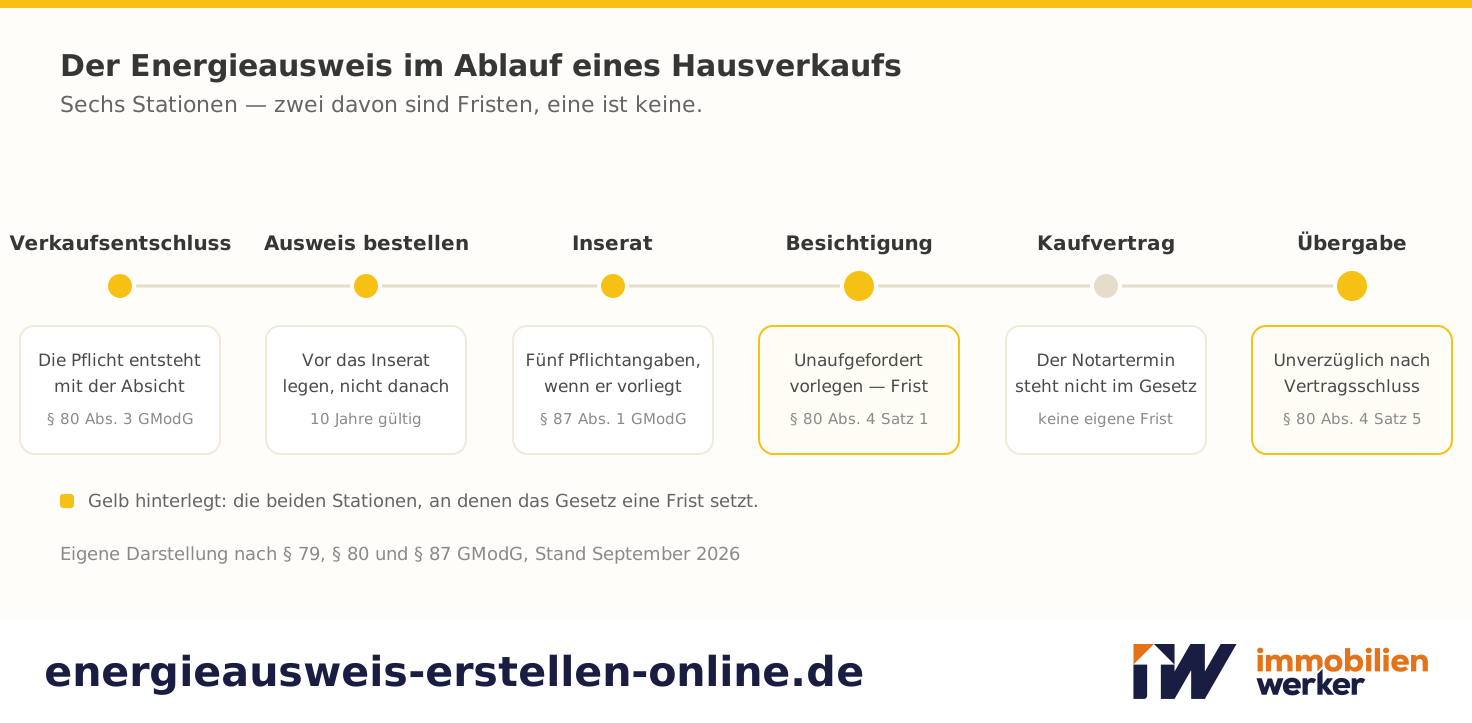
The energy performance certificate along the sale process
-
Sale is decided
The duty arises with the intention, not with a date. From here the certificate is owed — order it now, not later.
§ 80 (3)
-
Listing goes online
If the certificate exists, the five mandatory details belong in the advertisement — otherwise it is permissible without them too.
§ 87 (1)
-
First viewing
The first hard deadline. The certificate or a copy is to be presented unasked; a visible display or laying it out on site is sufficient.
§ 80 (4) s. 1
-
Notary appointment
It does not appear in the Act. It is a good occasion to record the handover — it creates no deadline of its own.
no deadline
-
After the purchase contract
The second hard deadline. You hand over the certificate or a copy immediately — regardless of whether the buyer asks for it.
§ 80 (4) s. 5
“Immediately” (unverzüglich) does not mean “at once” but without culpable delay — that is how § 121 (1) of the German Civil Code (BGB) defines it. There is no fixed number of hours: anyone who has the certificate as a PDF in the customer portal owes it sooner than someone who first has to request it.
| Situation | What to do | Reference |
|---|---|---|
| A viewing takes place | Present the certificate or a copy at the viewing at the latest | sentence 1 |
| Instead of handing it across | A clearly visible display or laying it out during the viewing is sufficient | sentence 2 |
| No viewing takes place | Present it immediately, without anyone asking | sentence 3 |
| The prospective buyer requests it | Present it immediately at the latest then | sentence 4 |
| After conclusion of the purchase contract | Hand it over immediately, original or copy | sentence 5 |
Source: Own illustration based on § 80 (4) GModG, as of September 2026
One special feature applies only when selling a residential building with no more than two flats: after the handover the buyer is to hold an informational advisory meeting on the certificate — but only if such a meeting is offered free of charge as a separate service (§ 80 (4) sentence 6 GModG). On 1 January 2027 this sentence is abolished without replacement.6
The Act prescribes no form, by the way: it requires “an energy performance certificate or a copy thereof” — a file sent by e-mail fulfils that. From 2027 the certificate is in any case issued digitally and machine-readable; paper is available on request.
What happens if it is missing or comes too late?
A missing certificate does not make the purchase contract invalid. It becomes expensive nonetheless — in three mutually independent ways.
| Route | Who acts | What is at stake |
|---|---|---|
| Regulatory offence | the authority competent under state law | fine of up to 10,000 euros |
| Competition law | competitors or associations, without any authority | warning letter, cease-and-desist declaration, reimbursement of costs |
| Civil law | the buyer | dispute over the figures, in exceptional cases claims |
Regulatory offence. Anyone who fails to present in time (§ 108 (1) no. 18 GModG), fails to hand over (no. 19) or omits the mandatory details (no. 21) acts unlawfully; § 108 (2) no. 2 provides for a fine of up to ten thousand euros.5 Intent is not required; recklessness is enough. The figure of 15,000 euros in circulation appears nowhere in the Act, and the 50,000-euro ceiling under § 108 (2) no. 1 concerns construction, retrofitting and technical systems, never the energy performance certificate. On 1 January 2027 the numbers shift by one; the amount stays.6
Competition law. The Higher Regional Court of Hamm has ruled that missing mandatory details in a property advertisement breach the Act against Unfair Competition because they are material to a consumer’s decision; it considered the warning-letter costs of 245 euros justified.11 The decision was handed down in 2016 on the identically worded predecessor provision. This route needs no authority — and property advertisements are publicly visible.
Civil law. Here the position is more sober than many guides suggest. There is no automatic price reduction for a poor efficiency class, and the mere handing over of an energy performance certificate is, according to the case law of the Higher Regional Court of Schleswig, not an agreement on quality within the meaning of § 434 BGB: anyone with the usual exclusion of warranty in the notarial contract is in principle not liable for incorrect certificate values; recourse lies against the issuer.10 There is no ruling by the highest court on this so far.
The exception is fraudulent intent, and it is the real reason for care. This is exactly where the allocation of roles in § 83 GModG applies: for the data you provide, you are responsible, for the data the issuer determines themselves, the issuer is — and the issuer may not rely on your details if there are doubts about their accuracy.3 Whether your details are checked before issue therefore weighs more than the price; what a certificate costs is explained under energy performance certificate costs.
Consumption or demand certificate — do you have the choice when selling?
As a rule, yes. § 79 (1) sentence 2 GModG places both routes on an equal footing,1 and the occasion “sale” in itself prescribes no type.
One exception hits precisely the typical sale case — the older detached house. § 80 (3) sentence 2 GModG requires a demand certificate for residential buildings that have fewer than five flats and for which the building application was made before 1 November 1977.2 Sentence 3 exempts from this again what already met the level of the 1977 Thermal Insulation Ordinance on completion or was later brought up to it. Both conditions must come together: a house from 1968 with five flats does not fall under it, nor does a house from 1980.
| Your building | Until 31 Dec 2026 | From 1 Jan 2027 |
|---|---|---|
| Building application from 1 Nov 1977 | free choice | free choice |
| Fewer than five flats, building application before that, no proof of the insulation level | demand certificate only | free choice |
| Fewer than five flats, building application before that, 1977 insulation level proven | free choice | free choice |
| Five flats or more | free choice | free choice |
The right-hand column is the news hardly anyone has reported so far: on 1 January 2027 the 1977 rule for residential buildings is abolished entirely. The new § 80 (3) sentence 2 requires the energy balance only for non-residential buildings, and Article 9 (2) of the amending Act sets this part to 1 January 2027.6 Anyone selling an unrenovated older house then has the same choice as everyone — for 2026 the rule remains the decisive switch. Which type is the more meaningful is explained in the comparison consumption or demand certificate.
How does the efficiency class affect the price?
What is certain: the efficiency class has an effect, more strongly for houses than for flats, and the effect has grown since the rise in interest rates in 2022. What is not certain is a figure for your house — there is no official statistic on purchase prices by efficiency class, only analyses of asking prices.
The most recent comes from immowelt, published on 19 March 2026. It examined flats and houses offered for sale on immowelt.de in 2025; measured was the deviation from the median standard of class D, with location, size and fittings factored out arithmetically.12
Data as a table
| Label | Value in % below class D |
|---|---|
| Class E | 4 |
| Class F | 7 |
| Class G | 10 |
| Class H | 17 |
| Efficiency class | Houses | Flats |
|---|---|---|
| A+ | +15 % | +20 % |
| A | +7 % | +15 % |
| B | +4 % | +8 % |
| C | +1 % | +1 % |
| D | reference | reference |
| E | −4 % | −1 % |
| F | −7 % | −2 % |
| G | −10 % | −6 % |
| H | −17 % | −9 % |
Three caveats belong here, otherwise the figures are misread: they are asking prices, not notarised purchase prices; it is one portal, not the whole market; and it is a national average. For flats the discount is markedly smaller — plausibly because an owners’ association bears the renovation costs jointly.
For your sale this yields no price formula but a sequence: the class is on the certificate, the certificate feeds the advertisement, and the advertisement decides who comes to the viewing. A certificate that shows an unnecessarily poor class because insulation or a heating replacement was not recorded costs more than its preparation. So have proof of modernisations ready before ordering, not afterwards.
Special cases: inherited house, heritable building right, forced sale, demolition, listed building
Five constellations regularly lead to the wrong sequence when selling. All buildings without a certificate duty are listed in the German article on certificate exemptions; here it is about your task.
| Case | What applies | Basis |
|---|---|---|
| Inherited house | Inheritance itself triggers nothing. As soon as you sell, the normal duty applies | § 80 (3) sentence 1 GModG |
| Heritable building right | Creation and transfer are treated like a sale | § 80 (3) sentence 1 GModG |
| Forced sale | The award is acquisition of ownership by sovereign act, not a sale — no certificate duty | § 90 ZVG, official interpretation |
| Sale for demolition | Official interpretation: a certificate would be contrary to its purpose. Does not apply to mere need of renovation or vacancy | official interpretation, no statutory provision |
| Listed building | Exempt until 31 Dec 2026; from 1 Jan 2027 the exemption is abolished without replacement | § 79 (4) sentence 2 GModG; amending Act |
Two of these rows deliberately stand without a section number: demolition and forced sale are not statutory exemptions but interpretation — to be found in the frequently asked questions of the federal GModG information portal.7 On demolition the federal government relies on the explanatory memorandum to the predecessor provision: if a building is sold with a view to imminent demolition, it would be obviously contrary to the purpose to require a certificate. Need of renovation, vacancy and a change of use planned after the sale are expressly not enough, and in case of doubt the state authority decides, not the seller. In a forced sale the award under § 90 ZVG makes the successful bidder the owner by sovereign act;8 § 80 (3) covers only contractual transactions. Anyone who later resells the property privately is back under the normal duty.
For a listed building a look at the calendar is worthwhile. Until 31 December 2026 listed buildings are exempt from issuing, presenting, handing over and displaying; this includes a building in an ensemble protected under state law. On 1 January 2027 the exemption is abolished without replacement — the new § 79 (4) names only buildings for national and alliance defence and small buildings.6
For an inherited house the duty is the smaller part of the problem; the documents are the harder part. Estates rarely contain a valid certificate, and often not the heating bills from which a consumption certificate could be prepared either. Heirs can obtain both — bills from the utility, year of construction and living space from the building file at the building authority. It just takes time, and the first viewing does not wait.
Questions sellers ask before the first viewing appointment
Do I already need the certificate before I place the listing?
Legally no — the five mandatory details apply only if a certificate exists at the time the advertisement is placed. Practically yes, because it must be there by the first viewing at the latest, and that usually follows the listing within days.
Is it enough to hand over the certificate at the notary appointment?
No. It is presented at the viewing at the latest and handed over immediately after the purchase contract is concluded. The notary appointment lies in between and does not appear in the Act.
Do I have to show the certificate even if nobody asks for it?
Yes. At the viewing it is to be presented, displayed or laid out unasked. The prospective buyer’s request only marks the latest deadline for the case that no viewing takes place at all.
Does the certificate have to be handed over on paper?
No. The Act requires the certificate or a copy without prescribing a form — a file sent by e-mail is sufficient. From 2027 it is in any case issued digitally and machine-readable, paper on request.
What if my certificate expires during marketing?
Then it no longer fulfils the duty from that day. A certificate is valid for ten years from issue; check the date at the start of marketing, not before the notary appointment.
My agent takes care of everything — does that let me off the hook?
No. The Act names the seller and the estate agent side by side; both are under the duty. You have to have the certificate issued, and without it the agent cannot present it either.
Conclusion: the certificate belongs at the start, not at the end
The duty arises with the decision to sell, the first hard deadline is the viewing, the second the handover after the contract is concluded. The notary appointment, where many assume the certificate belongs, does not appear in the Act. First check whether a valid certificate still exists for the building, then settle the certificate type — for a small older house with a building application before November 1977 the choice is not free until the end of 2026. Anyone who deals with both before the listing has the rest of the marketing free.
Sources
- Building Modernisation Act (GModG), § 79 — Principles of the energy performance certificate (version 09/2026) gesetze-im-internet.de ↩1 ↩2 ↩3
- Building Modernisation Act (GModG), § 80 — Issuing and use of energy performance certificates (version 09/2026) gesetze-im-internet.de ↩1 ↩2 ↩3 ↩4
- Building Modernisation Act (GModG), § 83 — Determination and provision of data (version 09/2026) gesetze-im-internet.de ↩
- Building Modernisation Act (GModG), § 87 — Mandatory details in a property advertisement (version 09/2026) gesetze-im-internet.de ↩1 ↩2
- Building Modernisation Act (GModG), § 108 — Provisions on fines (version 09/2026) gesetze-im-internet.de ↩1 ↩2
- Act amending the Building Energy Act and further provisions in the heating sector, Federal Law Gazette 2026 I No. 226 of 28 July 2026 — Article 2 enters into force on 1 January 2027 recht.bund.de ↩1 ↩2 ↩3 ↩4 ↩5 ↩6
- Federal GModG information portal (BBSR), frequently asked questions on energy performance certificates (retrieved 2 September 2026) gmodg.bund.de ↩1 ↩2 ↩3
- Act on Forced Sale and Receivership (ZVG), § 90 — Effect of the award gesetze-im-internet.de ↩
- Directive (EU) 2024/1275 on the energy performance of buildings, Article 20 — Issue of certificates eur-lex.europa.eu ↩
- German Notary Institute (DNotI), Higher Regional Court of Schleswig, judgment of 13 March 2015 – 17 U 98/14, handing over the energy performance certificate is not an agreement on quality (retrieved 2 September 2026) dnoti.de ↩
- German Notary Institute (DNotI), Higher Regional Court of Hamm, judgment of 4 August 2016 – 4 U 137/15, missing mandatory details in property advertisements as a competition-law breach (retrieved 2 September 2026) dnoti.de ↩
- immowelt, analysis of purchase listings advertised in 2025 by energy efficiency class, press release of 19 March 2026 (market observation, asking prices) immowelt.de ↩1 ↩2
This article reflects the position at the time of publication and does not replace legal or energy advice in an individual case. Binding are the Building Modernisation Act (Gebäudemodernisierungsgesetz, GModG) in its applicable version and the details in the issued energy performance certificate.