Energy performance certificate fines: six offences, two maximum amounts

Christoph Werker Energieberater & Geschäftsführer
As of:
“Fines of up to 10,000 euros” appears in almost every text on the energy performance certificate, and that is where the information ends. This article is written for owners who are currently selling or letting to new tenants — and for the estate agents who advertise for them. Behind the figure are six regulatory offences with different addressees, and the maximum amount is a framework, not a price tag.

The article goes through the six offences one by one and explains how fines are set. After that: who is liable, what belongs in the advertisement, who checks.
What exactly is a regulatory offence in connection with the energy performance certificate?
A regulatory offence (Ordnungswidrigkeit) is a breach of the law that an administrative authority punishes with a fine — not a criminal offence, no entry in the certificate of good conduct. For the energy performance certificate (Energieausweis), § 108 (1) of the Building Modernisation Act (Gebäudemodernisierungsgesetz, GModG) names six of them, numbers 17 to 22, all carrying a fine of up to ten thousand euros under subsection 2 no. 2.1 The first half-sentence is decisive: only someone who acts intentionally or recklessly commits the offence.
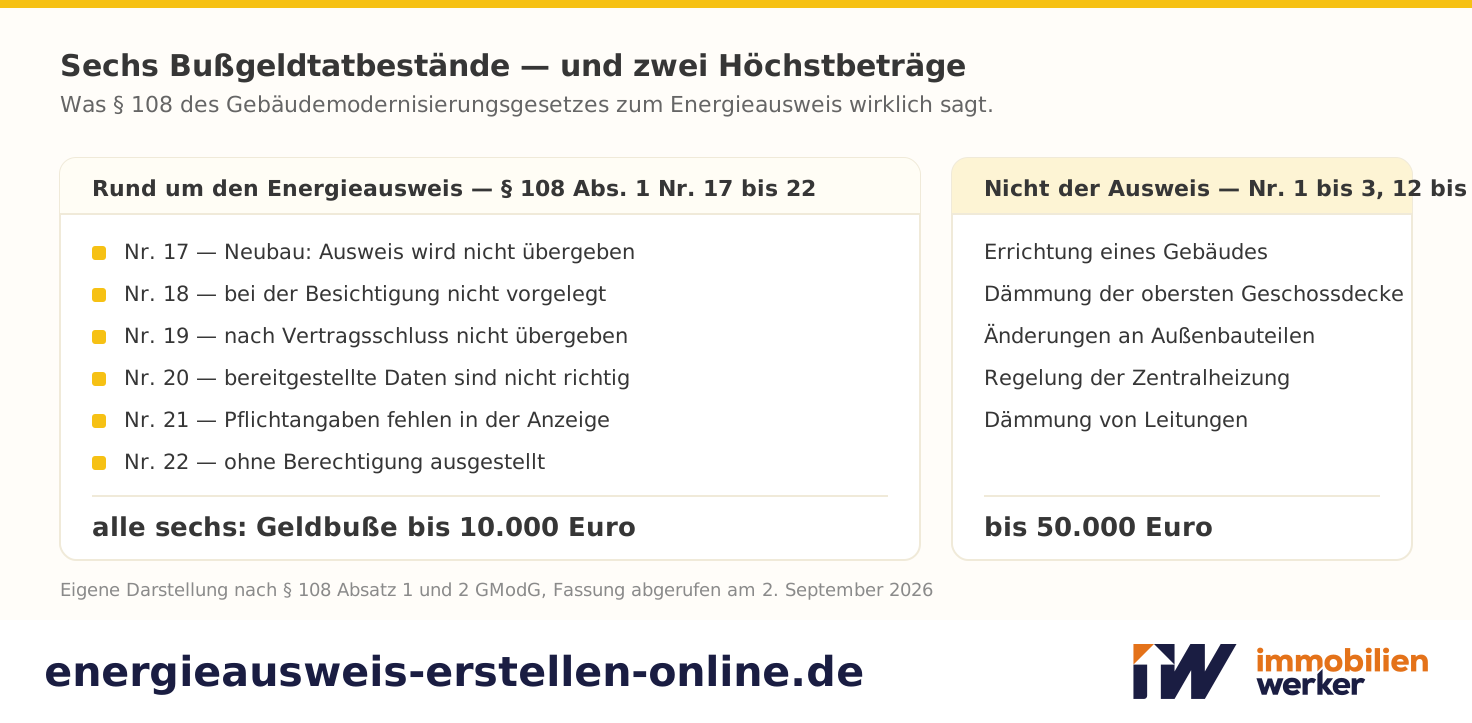
| What happened | Number | Reference provision | Maximum amount |
|---|---|---|---|
| New building: certificate not handed over | no. 17 | § 80 (1) sentence 2 | 10,000 € |
| Certificate not presented or presented too late | no. 18 | § 80 (4) sentences 1 and 4 | 10,000 € |
| Not handed over after the contract is concluded | no. 19 | § 80 (4) sentence 5 | 10,000 € |
| Data supplied is not correct | no. 20 | § 83 (1) s. 2, (3) s. 1 | 10,000 € |
| Mandatory details missing from the advertisement | no. 21 | § 87 (1) | 10,000 € |
| Issued without authorisation | no. 22 | § 88 (1) | 10,000 € |
Two things are easily overlooked here. The duty to display (§ 80 (6) and (7)) has no fine offence of its own; it can only be enforced via an order under § 95 GModG. And the much-quoted 50,000 euros apply under subsection 2 no. 1 to numbers 1 to 3 and 12 to 14 — construction, retrofitting under § 35, alterations under § 36, heating controls and pipe insulation — not to the certificate. On 1 January 2027 the numbers move back by one; the amounts stay the same.9
How high will the fine really be?
The maximum amount is an upper limit, not a standard fine. What the fine is based on is set out in § 17 of the Act on Regulatory Offences (Gesetz über Ordnungswidrigkeiten, OWiG): the significance of the offence, the blame attaching to the offender and their financial circumstances.6
Two rules shift the picture. Downwards: for a minor offence a caution with five to fifty-five euros is enough (§ 56 OWiG), and prosecution is at the authority’s discretion in any case (§ 47 OWiG). Upwards there is no hard limit — the fine is meant to exceed the financial benefit, if necessary beyond the maximum amount (§ 17 (4)).
- Recklessness (Leichtfertigkeit)
-
Recklessness is an aggravated form of negligence: anyone who acts recklessly disregards the required care to a particularly gross degree. Because § 108 (1) GModG requires intent or recklessness, someone who simply overlooks the certificate does not commit the offence.
How high fines turn out in practice cannot be put into figures seriously: there is neither a nationwide statistic nor a catalogue of fines from any federal state. Wherever ranges such as “200 to 3,000 euros” circulate, the source is missing.
Who is liable — the owner or the estate agent?
Both, and each in their own right. § 80 (4) GModG addresses the duty to present and hand over to “the seller or the estate agent”, and via subsection 5 likewise to landlords, lessors and leasing providers.3 The estate agent is not a messenger but an obligated party in their own right — they can only present what you give them.
§ 87 (1) is even clearer: it names all five roles “if one of these persons is responsible for publishing the property advertisement”. Under the former Energy Saving Ordinance (Energieeinsparverordnung) the estate agent was not an addressee — in 2017 the Federal Court of Justice (Bundesgerichtshof) had to cover them via competition law.12
Responsibility for the data runs separately: you are liable for your details, the issuer for those they determined themselves — and they must reject yours if in doubt (§ 83 GModG). Anyone who is not authorised to issue at all commits number 22; the requirements are set out under who may issue an energy performance certificate.
What must be in the advertisement?
If a certificate exists when the advertisement is placed and it appears in a commercial medium, § 87 (1) GModG requires five details.2 A note on the noticeboard is not a commercial medium.
The five mandatory details in the property advertisement
- Type of certificate — demand certificate under § 81 or consumption certificate under § 82
- Value of the final energy demand or final energy consumption
- Main energy sources for heating
- Year of construction — only for a residential building
- Energy efficiency class — only for a residential building
For a non-residential building, heat and electricity must be stated separately (§ 87 (2)). On 1 January 2027 the list is replaced: the date of issue is added, the annual primary energy demand takes the place of final energy, and the restriction to residential buildings is dropped.9
Who actually checks this?
Enforcement and application are a matter for the federal states. Two routes of control run side by side and affect different people.
| Feature | Spot check | Tip-off |
|---|---|---|
| Checks | data and results | presenting, handing over, advertisement |
| Affects | the issuer | owner, estate agent |
| Legal basis | § 99 GModG | § 95, § 108 GModG |
Source: Own illustration based on § 99 and § 114 GModG and the GEG information portal
The spot check is the systematic route: every certificate receives a registration number, a sample is drawn from the stock and checked in up to three stages — stage 1 electronically at the German Institute for Building Technology (DIBt), stages 2 and 3 at the state’s control office.10 That the DIBt takes this on is an interim solution under § 114 GModG.5 And if a spot check leads to fine proceedings, they are directed against the certificate issuer, not against you.4
There is no routine check of your own duties. The competent authority is one designated under state law, usually the lower building control authority — it acts because someone brings it in: a prospective buyer who missed out, or a competitor.11
Are there consequences besides the fine?
Two — the first is the quicker one. Missing mandatory details in the advertisement are a breach of competition law: in 2017 the Federal Court of Justice ruled that the details from the energy performance certificate are material information that may not be withheld from the consumer.12 Competitors and listed associations can issue a formal warning letter — no authority is needed for that.
The civil-law side is weaker than often claimed. According to the Higher Regional Court (Oberlandesgericht) of Schleswig, merely handing over the certificate does not establish an agreement on the quality of the property under § 434 of the German Civil Code (BGB).13 The position is different if the purchase contract expressly includes the energy characteristics or a defect was fraudulently concealed.
The certificate is missing or a letter has arrived — what now?
Catch up, correct, document. An energy performance certificate is valid for ten years (§ 79 (3) GModG)14 — there is no such thing as ordering too early; it can be commissioned online, and its details belong in every running advertisement. Adjust existing advertisements — the breach continues as long as the advertisement runs. Keep a record of when you presented the certificate to whom.
If a hearing form arrives, the authority names the number and the act. Check whether intent or recklessness is at issue and whether the offence lies more than two years back.
Frequently asked questions about the fine
Am I at risk of a fine if I have no energy performance certificate at all?
Not for that reason alone. What is punished is not the missing certificate but failing to present it, failing to hand it over and the incomplete advertisement. Without a sale and without a new letting none of these occasions arises.
What does it really cost if the certificate is missing?
10,000 euros is the maximum amount. The fine is set according to the significance of the offence and the blame (§ 17 (3) OWiG); in minor cases a caution is enough.
Is the estate agent liable instead of me?
In addition, not instead. § 80 (4) and § 87 (1) GModG name them as an addressee in their own right — you have to have the certificate issued yourself.
How long can a breach be prosecuted?
Two years from the end of the act — that is the limitation period for prosecution where the maximum fine is above 2,500 and up to 15,000 euros (§ 31 (2) no. 2 OWiG).
Conclusion: the framework is high, the effort small
Six offences, a maximum amount of 10,000 euros, fines set according to significance and blame — the often quoted 50,000 euros are not part of it. More important than the figure is who notices the breach: not a routine check but the prospective buyer or the competitor. Anyone who has the certificate ready before the first viewing and includes its five details in the advertisement will not come into contact with any of these offences.
Sources
- Building Modernisation Act (GModG), § 108 — Provisions on fines gesetze-im-internet.de ↩1 ↩2 ↩3 ↩4
- Building Modernisation Act (GModG), § 87 — Mandatory details in a property advertisement gesetze-im-internet.de ↩
- Building Modernisation Act (GModG), § 80 — Issuing and use of energy performance certificates gesetze-im-internet.de ↩
- Building Modernisation Act (GModG), § 99 — Spot checks of energy performance certificates gesetze-im-internet.de ↩
- Building Modernisation Act (GModG), § 114 — Interim enforcement tasks of the German Institute for Building Technology gesetze-im-internet.de ↩
- Act on Regulatory Offences (OWiG), § 17 — Amount of the fine gesetze-im-internet.de ↩
- Act on Regulatory Offences (OWiG), § 56 — Caution by the administrative authority gesetze-im-internet.de ↩
- Act on Regulatory Offences (OWiG), § 31 — Limitation period for prosecution gesetze-im-internet.de ↩
- Act amending the Building Energy Act and further provisions in the heating sector, Federal Law Gazette 2026 I No. 226 of 28 July 2026 recht.bund.de ↩1 ↩2
- Federal GEG information portal (BBSR), Checking of energy performance certificates and inspection reports bbsr-geg.bund.de ↩
- Verbraucherzentrale, “Für wen ein Energieausweis zur Immobilie Pflicht ist” (for whom an energy performance certificate is mandatory; as of 31 August 2026) verbraucherzentrale.de ↩1 ↩2
- Federal Court of Justice (Bundesgerichtshof), press release 149/2017 on cases I ZR 229/16, I ZR 232/16 and I ZR 4/17 bundesgerichtshof.de ↩1 ↩2
- German Notary Institute (Deutsches Notarinstitut), Higher Regional Court of Schleswig, judgment of 13 March 2015 — 17 U 98/14 dnoti.de ↩
- Building Modernisation Act (GModG), § 79 — Principles of the energy performance certificate gesetze-im-internet.de ↩
This article reflects the position at the time of publication and does not replace legal advice in an individual case. Binding are the Building Modernisation Act and the Act on Regulatory Offences in their applicable versions and the decision of the competent authority.