Is an energy performance certificate tax-deductible in Germany? Letting yes, own home no

Christoph Werker Energieberater & Geschäftsführer
As of:
The invoice for the energy performance certificate is on the table, and the obvious question is: will the tax office give you some of it back? This article is written for owners who have paid for the certificate. The answer hinges on a single factor: how the building is used.

Three types of use, three answers: let, owner-occupied, commercial. After that come the sale and the receipts where things most often go wrong.
Can I deduct the energy performance certificate from my tax?
The costs of an energy performance certificate (Energieausweis) are deductible if the building serves to generate income: when let, as income-related expenses (Werbungskosten); when used for business, as a business expense (Betriebsausgabe). If you live in it yourself, they are private expenditure with no tax effect — neither the certificate type nor an inspection changes that.
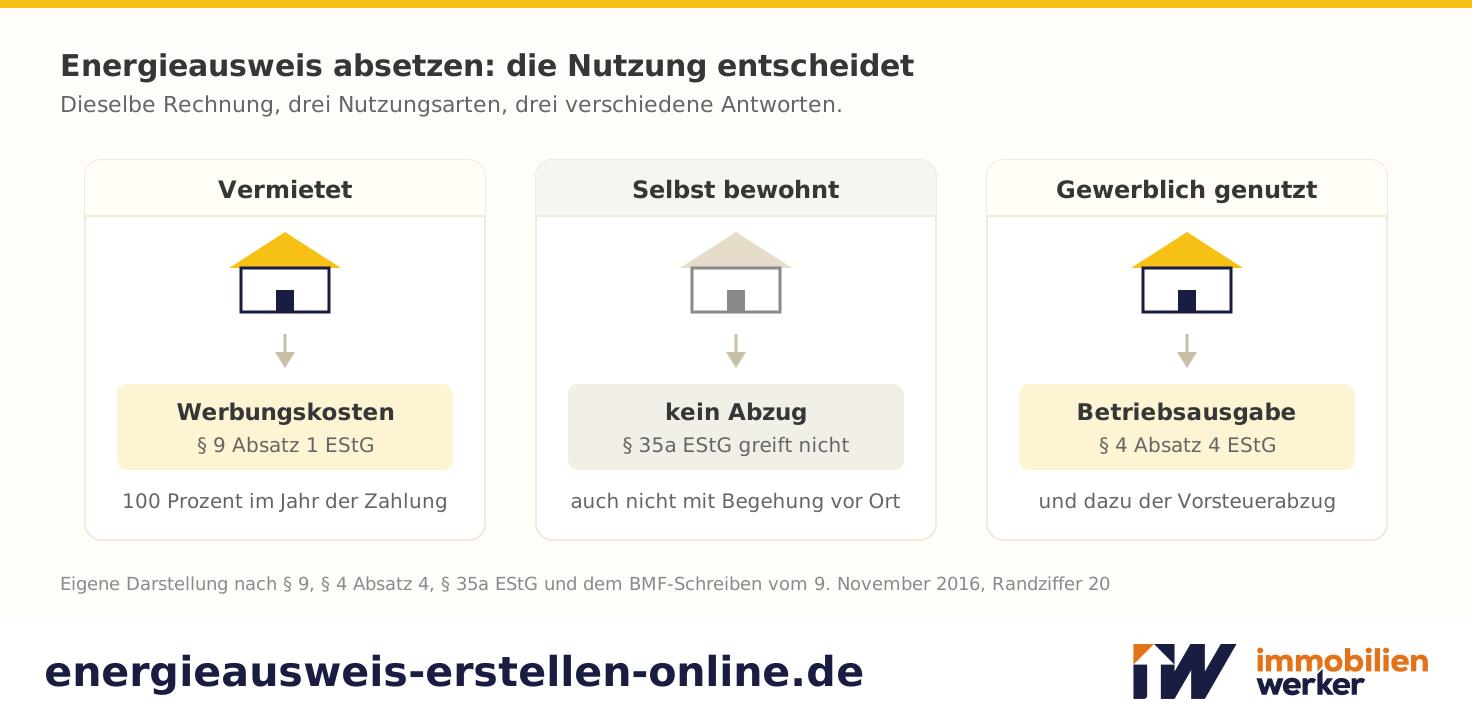
The reason is in the Act: under § 9 (1) sentence 1 of the Income Tax Act (Einkommensteuergesetz, EStG), income-related expenses are “expenses incurred to acquire, secure and maintain income”1 — without a type of income there is nothing to deduct them from. What the certificate costs is set out under energy performance certificate costs.
| Criterion | Let | Owner-occupied | Commercial |
|---|---|---|---|
| Legal basis | § 9 (1) EStG | none | § 4 (4) EStG |
| Type of deduction | income-related expenses | private expenditure | business expense |
| Share | 100 per cent | 0 per cent | 100 per cent net |
| Form | Annex V | none | profit determination |
| Input tax deduction | usually no | no | yes, if taxable |
The commercial case is the shortest: under § 4 (4) EStG, business expenses are expenses incurred by the business.4 In addition there is input tax deduction under § 15 of the Value Added Tax Act (Umsatzsteuergesetz, UStG), but only insofar as your own turnover does not exclude it.12 Residential letting does exactly that; it is exempt from VAT under § 4 no. 12 (a) UStG — there you deduct the gross amount, with taxable commercial letting the net amount.
Let flat or house: how and where do I enter it?
For a let property, the certificate costs are fully part of the income-related expenses for income from letting and leasing.2 They are entered in Annex V (Anlage V) under other income-related expenses; we do not give a line number, as it changes every year. The cause is a statutory duty: under § 80 (3) of the Building Modernisation Act (Gebäudemodernisierungsgesetz, GModG), every new letting triggers the duty to have a certificate — more on this under when an energy performance certificate is mandatory.
The deduction is made in the year of payment. The certificate is valid for ten years, but § 11 (2) sentence 1 EStG is unambiguous: expenses are to be deducted for the calendar year in which they were paid.3 No spreading, no capitalisation.
Vacancy does no harm; mixed use splits. § 9 (1) sentence 1 EStG looks to future income: anyone who orders while a new tenant is being sought has income-related expenses incurred in advance; an advertisement or an estate agent’s mandate proves the intention. And because the certificate applies to the building and not to the flat, anyone who lives downstairs and lets upstairs splits the costs — usually by usable area, which is exactly the yardstick the Federal Ministry of Finance prescribes for § 35c EStG.10
The same invoice, three types of use
Suppose the certificate costs 400 euros gross and the marginal tax rate is 30 per cent — both figures chosen, not collected. In the portal the demand certificate costs 119.90 €:
Owner-occupied: €400 × 0 % = €0
Let: €400 income-related expenses × 30 % = €120
Commercial and subject to VAT: €400 gross is €336.13 net plus €63.87 VAT. The input tax is refunded, the net amount reduces the profit: €63.87 + (€336.13 × 30 %) = €164.71
Result €0, €120 or €164.71
Owner-occupied: what works, what does not?
For an owner-occupied house there is no tax reduction — neither as a household-related service nor as a tradesman’s service. Marginal number 20 of the BMF circular of 9 November 2016 lists what § 35a EStG does not cover:8
Neither household-related services nor tradesmen’s services include, for example, activities that serve to determine value, the preparation of an energy pass, or activities in connection with financing.
Annex 1 to the same circular lists “Energiepass” (energy pass) — the pre-2007 term for the same document — in the column not eligible, whereas the chimney sweep and the fireplace inspection are listed as eligible.9 What decides is the nature of the service: someone who checks a system is doing a tradesman’s work; someone who prepares a document about the building is carrying out an assessment.
Nor does the counter-argument hold that the certificate is an ancillary service to an eligible tradesman’s service. The Federal Fiscal Court (Bundesfinanzhof) has rejected this pattern: for the structural calculation of a structural engineer, the reduction “cannot be granted even if it was necessary for carrying out a tradesman’s service”.11 A structural engineer provides planning and computational verification, not a trade — and that applies equally to the issuer of a demand certificate (Bedarfsausweis).
That leaves § 35c EStG. It does not help, for three reasons.
| Route | Legal basis | Outcome |
|---|---|---|
| Household-related service | § 35a EStG | blocked |
| Energy-related measure | § 35c (1) sentence 3 | blocked |
| Energy consultant | § 35c (1) sentence 4 | 50 per cent, only the consulting |
Source: Own illustration based on § 35a and § 35c EStG
The third route carries the most misunderstandings. § 35c (1) sentence 4 EStG grants a 50 per cent reduction for energy consultant costs6 — but only for a consultant approved by the Federal Office for Economic Affairs and Export Control (BAFA) who accompanies the measure in a planning capacity. The BMF circular of 21 August 2025 draws the line twice: anyone who only holds an authorisation to issue certificates is not an energy consultant (marginal number 55), and costs are only taken into account if at least one measure is carried out (marginal number 59).10 The certificate produced in the process is not included.
What about a sale?
On a sale, what matters is whether there is a taxable transaction at all. The sale of a property is a private disposal transaction only if no more than ten years lie between acquisition and disposal; excluded are properties that were occupied by the owner in the year of sale and the two preceding years.7
If there is such a transaction, the certificate costs reduce the gain: § 23 (3) sentence 1 EStG calculates it as the sale price minus acquisition costs and income-related expenses. These include the estate agent, notary, advertisements and valuations. This is declared in Annex SO (Anlage SO), not in Annex V; the two are often confused. Below a total gain of 1,000 euros per year, everything remains tax-free.
Anyone who has owned the property for more than ten years or lived in it themselves, on the other hand, has nothing to deduct.
Which receipts do I need?
For income-related expenses and business expenses, proper evidence is sufficient. For § 35a and § 35c EStG the form is a condition of entitlement: § 35a (5) sentence 3 EStG requires an invoice and “that payment was made to the account of the provider of the service”.5 Paid in cash means lost; a later bank transfer does not cure it.
What to keep and what the invoice should show
- The invoice, in your name and with the address of the building
- Proof of payment: bank statement or transfer receipt, not a cash receipt
- Where several services appear on one receipt, the labour costs shown separately
- For partial letting, the areas from which the share was calculated
- The certificate itself — it proves the occasion
Anyone who orders online has the payment route documented; invoice and certificate are in the customer portal: consumption certificate or demand certificate.
Frequently asked questions about the tax treatment
Is preparing an energy performance certificate a household-related service?
No. Marginal number 20 of the BMF circular of 9 November 2016 expressly names the preparation of an energy pass as something that belongs neither to household-related services nor to tradesmen’s services.
Do I have to spread the costs over the ten years of validity?
No. Under § 11 (2) sentence 1 EStG, expenses are deducted in the calendar year in which they were paid — for a let property, therefore, the full amount in the year of payment.
I am having renovation work done — can I deduct the certificate under § 35c EStG?
Not the certificate. § 35c (1) sentence 3 EStG lists eight measures exhaustively, and the energy performance certificate is not among them. What is eligible, at 50 per cent, are the costs of an approved energy consultant who accompanies a measure that is carried out.
Energy consultant deducted — which form does that go in?
Three cases, three forms: the landlord’s income-related expenses in Annex V, costs of disposal on a sale in Annex SO, the reduction under § 35c EStG in the Annex for Energy-Related Measures.
Conclusion: use decides, not the certificate
If you let, you deduct the energy performance certificate in full in the year of payment; if you use the building for business, you book it as a business expense; if you live in it yourself, you bear it privately. Keep the invoice and proof of payment all the same: the use of a building changes faster than the validity of its certificate.
Sources
- Income Tax Act (EStG), § 9 — Income-related expenses gesetze-im-internet.de ↩1 ↩2
- Income Tax Act (EStG), § 21 — Income from letting and leasing gesetze-im-internet.de ↩
- Income Tax Act (EStG), § 11 — Receipt and payment gesetze-im-internet.de ↩
- Income Tax Act (EStG), § 4 — Concept of profit in general, subsection 4: business expenses gesetze-im-internet.de ↩
- Income Tax Act (EStG), § 35a — Tax reduction for household-related services and tradesmen's services gesetze-im-internet.de ↩1 ↩2
- Income Tax Act (EStG), § 35c — Tax reduction for energy-related measures on buildings used for one's own residential purposes gesetze-im-internet.de ↩1 ↩2
- Income Tax Act (EStG), § 23 — Private disposal transactions gesetze-im-internet.de ↩
- Federal Ministry of Finance (BMF) circular of 9 November 2016 on § 35a EStG, marginal no. 20 (full text on the Mecklenburg-Western Pomerania tax portal) steuerportal-mv.de ↩1 ↩2
- Annex 1 to the BMF circular on § 35a EStG as amended on 1 September 2021, line “Energiepass” (Thuringia tax office) finanzamt.thueringen.de ↩1 ↩2
- BMF circular of 21 August 2025, individual questions on § 35c EStG, marginal nos. 53 to 59 bundesfinanzministerium.de ↩1 ↩2 ↩3
- Federal Fiscal Court (Bundesfinanzhof), judgment of 4 November 2021, VI R 29/19 — no tax reduction for structural calculations by a structural engineer bundesfinanzhof.de ↩
- Value Added Tax Act (UStG), § 15 — Input tax deduction gesetze-im-internet.de ↩
This article sets out the legal position in general terms and does not replace tax advice in an individual case. Whether and to what extent you can deduct costs depends on your personal circumstances. Under § 2 of the Tax Advisers Act (Steuerberatungsgesetz), only those authorised to do so may provide professional assistance in tax matters — we are not. Binding are the Income Tax Act in its applicable version, the circulars of the Federal Ministry of Finance and the decision of your tax office.