Demand certificate costs: why it costs more and what a fair price includes

Marco Bisch Energieberater
As of:
A consumption certificate costs 69.90 € in this portal, a demand certificate 119.90 € — and with an on-site appointment the same task quickly becomes several hundred euros. This article is written for owners of an older residential building who are facing this bill and want to know what they are paying the difference for.

The short answer: the demand certificate is not a more expensive piece of paper but a different service. The article shows what it costs in 2026, why it is priced above the consumption certificate, what drives the price and how to recognise a complete quote.
What does a demand certificate cost in 2026?
A demand certificate (Bedarfsausweis) is the energy performance certificate (Energieausweis) that calculates a building’s energy demand instead of evaluating its consumption: the issuer records the areas of the building elements, insulation and building services and uses them to balance the demand under standardised conditions (§ 81 (2) of the Building Modernisation Act, Gebäudemodernisierungsgesetz, GModG).2 In this portal it costs 119.90 €.
On the market the price depends above all on whether someone travels out to collect the data. The ranges come from co2online — there is no official price statistic.
| Way of issuing | Price range | As of |
|---|---|---|
| Ordered online, data from the owner | around 100 euros | 12/2021, co2online |
| With on-site data collection | 300–500 euros | 12/2021, co2online |
| Larger building, on site | around 300 euros base fee plus 30–50 euros per dwelling | 12/2021, co2online |
| In this portal, online | 119.90 € | 09/2026 |
What an energy performance certificate costs overall is set out in the overview energy performance certificate costs; the counterpart to this article is consumption certificate costs.
Why is it more expensive than the consumption certificate?
Because the two certificates determine the same figure in two ways. The consumption certificate (Verbrauchsausweis) evaluates bills from 36 consecutive months (§ 82 GModG),3 adjusts them for weather and vacancy and divides the result by the area. From 2027, 24 months are sufficient.9 Arithmetic on existing papers.
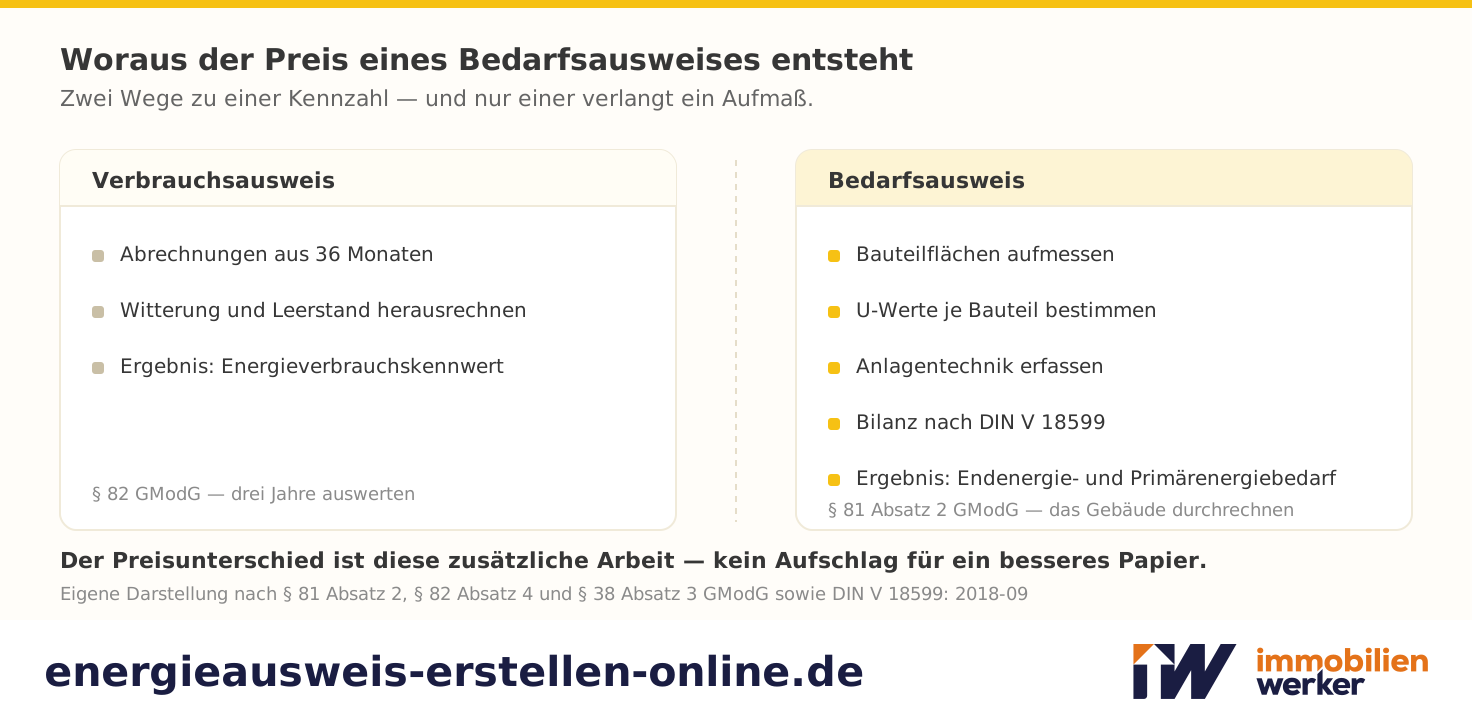
The demand certificate, by contrast, models the building. Via § 81 (2) and § 38 (3) GModG it arrives at the method of § 20 (1) — the balance under DIN V 18599 in the 2018-09 version.7 For this every surface of the heat-transmitting envelope needs a measurement and every building element a thermal transmittance coefficient.
| Building element | What is recorded |
|---|---|
| Roof, external wall, cellar ceiling | Area and construction |
| Windows | Area, glazing, frame |
| Building services | Generator, storage, distribution |
Source: Own illustration based on § 81 (2) GModG
This is exactly where the price lies. If building plans are missing, the dimensions may be determined by a simplified survey and empirical values for comparable age groups may be used for unknown building elements (§ 38 (4) GModG).6 How this is done is set out in an official notice 31 pages long — with the requirement that the measurement tolerance should not exceed three per cent.10 Regulated engineering work, and it takes time.
What does not explain the difference: the visit to the house. The issuer has to inspect an existing building anyway or be shown it in photographs — for every energy performance certificate (§ 84 (1) GModG).5
| Cost driver | Consumption certificate | Demand certificate |
|---|---|---|
| Data basis | existing bills | survey of the building |
| Calculation method | evaluation and adjustment | balance under DIN V 18599 |
| Effort per building element | none | area and U-value individually |
| Price in the portal | 69.90 € | 119.90 € |
| On the market online, 12/2021 | 50–100 euros | around 100 euros |
| Apartment building, 12/2021 | around 250 euros | 300 euros plus 30–50 euros per flat |
What does the price depend on in the individual case?
The consumer advice centre (Verbraucherzentrale) names four factors: building size, the effort of recording the building elements, the heating system and the available building documents.13
Four features that move the price
Size and dwellings
Every additional flat brings its own areas. On site it adds 30 to 50 euros.
Irregular envelope
Extension, dormer, conservatory, bay window — every projection is a separate surface.
Documents
If floor plans, sections and elevations are available, the survey is largely unnecessary. If they are missing, it is the biggest item.
Additional services
Express and postal delivery are surcharges on the base price — the same for both certificate types.
When do I have no choice?
In three cases the Act prescribes the demand certificate, and then the cheaper route is not permitted: for a new building (§ 80 (1) GModG), after major alterations with a calculation for the whole building (§ 80 (2)) and — the most common case — for a residential building with fewer than five flats for which the building application was filed before 1 November 1977 (§ 80 (3) sentence 2 GModG).1 The third case applies only until the end of 2026.
It has an exception that is rarely told in full: it does not apply if the house already met the requirement level of the Thermal Insulation Ordinance (Wärmeschutzverordnung) of 1977 on completion or was brought up to it later. The exception is not free, though — it has to be proven via the mean thermal transmittance coefficient or the U-values of all building elements, that is, via a calculation of its own.
What belongs in the price — and what is charged extra?
The Act prescribes several components. A quote without them is not a cheaper one but an incomplete one:
This must be included in the price
- Registration number at the German Institute for Building Technology (DIBt) — the issuer applies for it and pays for it (§ 98 GModG), 6.90 euros per certificate
- Modernisation recommendations — a mandatory component unless no measure is technically possible (§ 84 GModG)
- Checking your details — if in doubt, the issuer may not use them (§ 83 (3) GModG)
- Inspection or meaningful photographs of the building (§ 84 (1) GModG)
- Correction of evaluation errors — to be settled in the contract, not regulated by law
Not included is energy advice: “Energy advice is not included with either type of certificate,” writes the Verbraucherzentrale.13 Anyone who wants it commissions it separately — BAFA subsidises it with 50 per cent of the eligible fee, up to a maximum of 650 euros for one- and two-family houses.14
One point that gets lost with cheap quotes: you are liable for the data you supply. Anyone who passes it on unchecked is not selling a bargain but a risk.
Can I deduct the costs?
Landlords deduct the demand certificate as income-related expenses (Werbungskosten), in full in the year of payment. Owner-occupiers cannot; for them at most the tax reduction for household-related services comes into consideration, and only if a service was provided in the household — so not for a purely online issue. Details and maximum amounts are in energy performance certificate as a tax deduction.
Frequently asked questions on the costs of the demand certificate
Is a demand certificate valid without an inspection?
Yes. § 84 (1) GModG expressly permits suitable photographs as an alternative. The Verbraucherzentrale nevertheless recommends an inspection for demand certificates, because data collection is otherwise prone to errors.
What does a demand certificate for an apartment building cost?
With on-site recording co2online quotes a base fee of around 300 euros plus 30 to 50 euros per dwelling (as of 12/2021).
Why is a demand certificate so cheap with some providers?
Because there the owner enters the building data themselves and there is no travel. That is permitted — but under § 83 (3) GModG responsibility for its correctness then lies with you.
Is it worth waiting until 2027 to order?
Only if no viewing is coming up. From 1 January 2027 residential buildings may choose freely, so the cheaper consumption certificate will be possible more often.
Do I get renovation advice with the demand certificate?
No. Modernisation recommendations are a mandatory component (§ 84 GModG), advice is not. It is commissioned separately and subsidised by BAFA.
Conclusion: you pay for a survey, not for a seal
The demand certificate costs more because someone breaks your house down into areas, U-values and plant components and calculates a balance from them. How expensive it is depends on the data available: with building plans it stays manageable, without them the survey becomes the biggest item. So check not so much the final amount as what it contains — and whether you need one at all. Until 2027 the quickest route is the demand certificate online.
Sources
- Building Modernisation Act (GModG), § 80 — Issuing and use of energy performance certificates gesetze-im-internet.de ↩
- Building Modernisation Act (GModG), § 81 — Energy demand certificate gesetze-im-internet.de ↩
- Building Modernisation Act (GModG), § 82 — Energy consumption certificate gesetze-im-internet.de ↩
- Building Modernisation Act (GModG), § 83 — Determination and provision of data gesetze-im-internet.de
- Building Modernisation Act (GModG), § 84 — Recommendations for improving energy efficiency gesetze-im-internet.de ↩
- Building Modernisation Act (GModG), § 38 — Energy assessment of an existing building gesetze-im-internet.de ↩
- Building Modernisation Act (GModG), § 20 — Calculation of the annual primary energy demand of a residential building gesetze-im-internet.de ↩
- Building Modernisation Act (GModG), § 98 — Registration number gesetze-im-internet.de
- Act amending the Building Energy Act and further provisions in the heating sector, Federal Law Gazette 2026 I No. 226 of 28 July 2026 recht.bund.de ↩1 ↩2 ↩3
- Notice of the rules on data collection and data use in the existing residential building stock of 8 October 2020 (BAnz AT 04.12.2020 B1) bundesanzeiger.de ↩1 ↩2
- German Institute for Building Technology (DIBt), GEG registration office — quota and fees (retrieved 09/2026) dibt.de ↩
- co2online, demand certificate or consumption certificate: comparison (as of 17.12.2021) co2online.de ↩
- Verbraucherzentrale, “So kommen Sie an einen Energieausweis für Ihre Immobilie” (how to obtain an energy performance certificate for your property; as of 09.10.2025) verbraucherzentrale.de ↩1 ↩2
- Federal Office for Economic Affairs and Export Control (BAFA), federal funding for energy advice for residential buildings (as of 30.04.2026) bafa.de ↩
- Building Modernisation Act (GModG), § 79 — Principles of the energy performance certificate gesetze-im-internet.de ↩